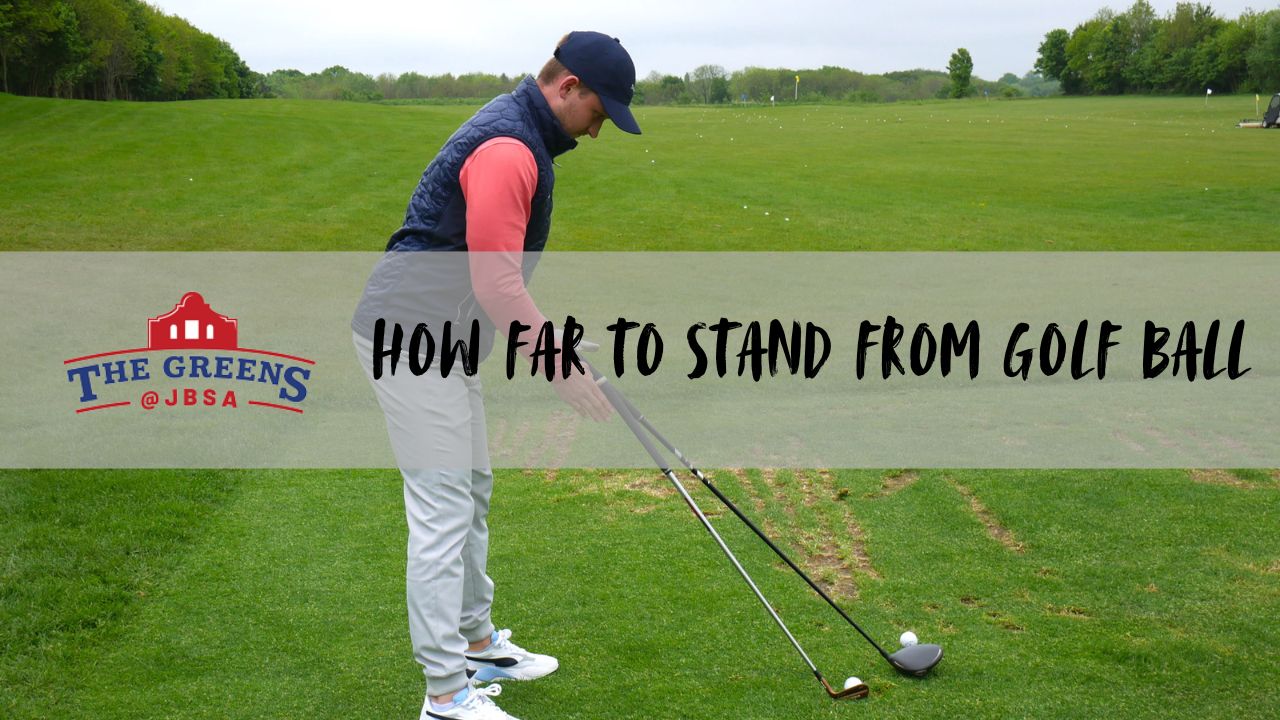
Most golfers take hours of practice on their swing but fail to notice one simple fact that influences each of their shots: how far the ball is. Even a perfectly good swing might give bad performance due to incorrect setting. Being too close will give one a cramp motion and being too distant will give one a reach and unequal contact. The concept of how far to stand from golf ball is not learning a rule to the very basics. It concerns developing a system that will enable your body to move in a natural and efficient way. The combination of your posture, balance, and distance will make contact more solid to repeat.
This manual will have you reach the proper range with each club, the pitfalls that golfers should avoid, drills that are easy to perform and minimal checkpoints that will have you creating a more stable setup.
How Far to Stand From Golf Ball?
The simplest method of discovering the right distance is to allow the arms to swing freely below the shoulders, having hinged forward at the hips.
When your hands are clenched around your legs, then you are probably standing too close. When you feel strained towards the ball you are likely to be too distant.
Why Distance From the Ball Matters More Than Most Golfers Think?
Numerous golfers emphasize grip, alignment, and swing path. All those are significant, but none are effective when you are having the wrong position as a starting point of your setup. The appropriate distance determines:
Swing plane
Clubface control
Balance
Consistency
Power transfer
Strike quality
Imagine your set-up as the basis of a house. When the base is weak then all the things that are laid above it will be weaker.
Once the golfers enhance their distance, they usually start seeing the difference in terms of striking the ball even more without undergoing significant changes in the swing.
A Simple Routine That Works With Every Club
Rather than guessing or figuring out where to position, repeat a procedure in front of each shot.
Step 1: Stand Tall
Start with your feet approximately a shoulder-width apart. Hold the club in front of your body. Do not bend at the waist at this point.
Step 2: Hinge From the Hips
Keep straight back and lean forward at the hips. Let your upper body swing towards the ball in a natural manner. This movement establishes an athletic pose yet does not make you posture.
Step 3: Add Knee Flex
When the club is nearing the ground, be sure to add a small amount of knee flex. Never squat down. The aim is not to sit down but balance.
Step 4: Let Your Arms Hang Naturally
Allow your arms to relax. These should dangle very comfortably under your shoulders. The position of your hands is to be about one hand-width below your lead thigh.
Step 5: Check Clubhead Position
With the ball, the center of the clubface should be directly behind it. Otherwise, do minor corrections either backward or forward.
This exercise will enable the golfers to gain some form of inertia irrespective of the club in use.
How Driver Setup Differs From Iron Setup?
One of the reasons why golfers get difficulty in spacing is because they put themselves at the same distance of each club. Varied positions are held by different club lengths.
Driver Setup
The driver is the largest club in bag. It is too long that you find yourself standing away. In your posture, you will include:
Slightly more forward bend
Wider stance
Arms further apart thereof.
Position of ball: forward in stance.
The positioning must be athletic and balanced and not curched.
Iron Setup
Irons are shorter compared to drivers. This causes you to be closer to the ball. Features of iron set-up include:
More upright posture
Bringing of hands nearer to thighs.
Compact appearance
Centered balance
This provides the circumstances of clean downward hits.
Comparison
Signs You Are Standing Too Close
Lots of golfers crowd the ball unknowingly. This restricts the free swinging area of the club.
Common Symptoms
Hands brushing thighs
Elbows folding excessively
Upright backswing
Heel strikes
Hooks and pulls
Feeling claustrophobic at speech.
When the golfers are at an excessively lower distance, the body tries to increase the height by lifting the body during the downswing. The compensation brings about inconsistency.
Quick Self-Test
Get into position on the set-up and waggle the club. In case you have your arms stuck up to your body, pull a little bit away. A slight change can bring about greater liberty.
Signs You Are Standing Too Far Away
Getting too distant is a different story altogether. Rather than feeling constricted, golfers do not associate themselves with the shot.
Common Symptoms
Coming to the ball.
Towards toes weight.
Toe strikes
Loss of balance
Inconsistent contact
Reduced control
Touching poorly with the bat is not a worry about a swing, rather a set-up problem in the eyes of many players. You are likely to need to move closer in case your arms are not relaxed, but your arms are stretched.
The Relationship Between Distance and Golf Stance

The distance of the ball and your golf stand are in agreement. They should not be regarded independently. A well balanced system enables the body to swing well without losing its balance during the swing. Good players seldom appear stiff when at address. Instead, they are trendy, casual, and motion-filled. In analyzing your setup, consider:
Balanced posture
Comfortable arm position
Stable foot pressure
Relaxed shoulders
Such aspects tend to be more important than precise measurements.
The One-Hand Rule That Many Golf Coaches Teach
An example of an easy point of reference that most instructors refer to is the distance between your hands and your lead thigh.
How It Works
Get your usual address posture. Eyeball the difference. Adequate space should be created between your grip and your lead thigh so that you can fit in 1 hand. This is not a strict rule.
Nonetheless, it offers a good point of departure to the majority of golfers. For a significant number of recreational players, the use of this checkpoint enables them to improve immediately.
Why Athletic Movement Beats Perfect Measurements?
Golfers will seek precise numbers. They desire to know just how many inches they should be from the ball. Regrettably, golf is not like that.
Body types vary.
Arm lengths vary.
Club specifications vary.
Flexibility varies.
The most important thing is to develop a position of an athlete that is movable. Consider other sports. A tennis player is a player who makes an adjustment prior to each serve. Before each pitch, a baseball player switches. The case with golf. Natural and helpful small adjustments before the swing.
Common Setup Mistakes That Affect Ball Striking
A lot of golfers have problems with contact due to minor set- up mistakes.
Frequent Mistakes
Fixing these problems can usually enhance performance more quickly than significant swing modification.
How Different Skill Levels Approach Setup?
Novices tend to make setups complicated. It is normally simplified by experienced golfers.
Beginners
Concentrate on precise positions.
Make frequent adjustments
Overthink measurements
Intermediate Players
Develop better awareness
Use checkpoints
Begin trusting feel
Advanced Golfers
Prioritize balance
Trust natural movement
Make subtle adjustments
This is the moral of the story. As a golfer, the more he is developing he no longer uses a lot of measurements but rather gains awareness of athleticity.
Conclusion
One of the easiest things to learn to enhance your consistency without training your swing mechanics is within what distance to stand of golf ball. The perfect position has your arms simply swinging, the body in equilibrium and the clubhead comfortably resting behind the ball. It doesn’t matter what club you are hitting with; be it a driver, fairway wood or even an iron, the aim is to achieve an athletic stance that is natural and replicable. With appropriate posture, weight balance and a repeatable set up routine, golfers can learn a more reliable golf stance and more effective proper golf stance on each swing of the club.
Frequently Asked Questions
How far should I stand from the golf ball with a driver?
Stand nearer away than in the case of irons since the driver is longer. Imagine there is no reaching with your arms.
How do I know if I am standing too close?
With cramped arms, rubbing hands against thighs, or hitting heel of club too often, you might be too near.
How do I know if I am standing too far away?
Tension will be highlighted by stretching, leaning forward on the toes, or striking from the toe position of the clubface.
Does height affect distance from the ball?
Yes. The taller golfers tend to be far apart as compared to shorter golfers, although the importance of proper positions is more of importance than measurement.
Should my setup change between clubs?
Yes. Clubs that are longer will need a bit more space, and shorter clubs will automatically be within closer reach to the ball.
Related Articles: