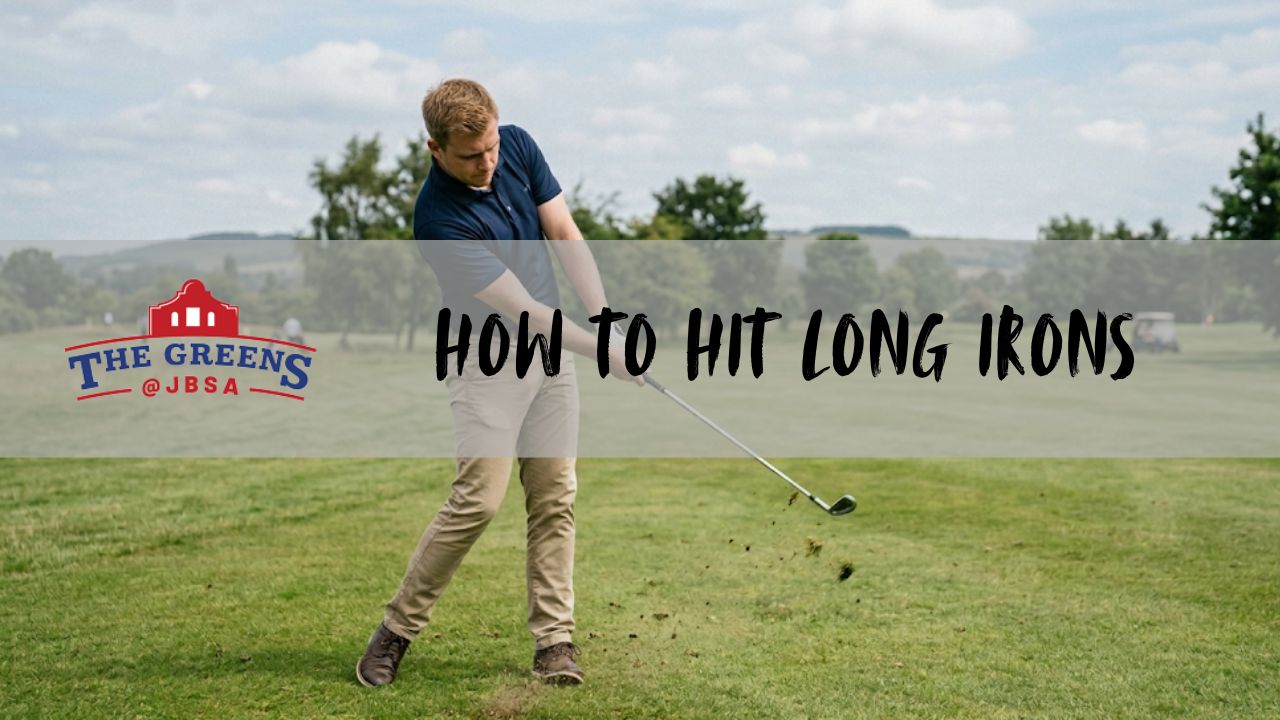
Long irons may be a bit threatening. So many golfers take a 3-iron, or 4-iron, or even a 5-iron out of the bag, and immediately begin to think of potential miss. Common problems include- thin shots, topped shots, weak fades and heavy contact. Nonetheless, it is not so hard to learn How To Hit Long Irons as many players may think.
The fact is that long irons are slightly different to short and medium-irons. The range of error is cut down by the club being less lofted and longer in shaft and requiring contact. Long irons should prove to be a dependable scoring clubs instead of a club to avoid joining, once you know how to set them up, attack angle, and body movements.
You may desire to hit long par-4 greens, or two-shot par-5s, or just to be a better ball striker; whatever you are doing, this guide will show you all you should know.
Quick Summary: How To Hit Long Irons Successfully
A cursory overview of the fundamentals is in order before going into deeper discussions.
These basics should also be mastered by golfers to experience an immediate effect on their launch, consistency and accuracy.
Why Long Irons Are Harder To Hit?
Long irons are a challenge to many amateur golfers as they attempt to swing harder instead of swings better. A short iron is higher than long iron. Due to this fact, the club depends more on you to achieve good impact to produce appropriate launch and carry distance. The slightest slip in contact may lead to a bad shot.
Examples of common reasons why golfers struggle are:
Ball too far back.
Swinging too steeply
Efforts to raise the ball up into the air.
Narrow backswing arc
Poor weight transfer
Deceleration of clubhead.
The upside is that each of the above problems is amenable to being rectified by appropriate fundamentals.
Understanding The Correct Ball Position
Another of the greatest errors that golfers commit is to position the ball in the middle of the stance. In the case of long irons, the ball must move a little forward. The approximate ball width of the lead heel is a good reference point.
The resulting setup alters the angle of attack to a shallower one and also enables the clubface to roll off with more loft at impact.
Benefits Of A Forward Ball Position
When your long irons are continually landing low and wanting to go weak, the first place you should look is the position of the ball.
The Secret To A Better Angle Of Attack
Hit too frequently long irons down. Both long irons and a wedge hit better with a shallow blow as compared to a wedge that requires a steeper blow. The turf should not be in contact before the club, yet the downward motion ought to be less drastic.
The convenient method is:
Wedge: Steeper strike
Mid Iron: Moderate blow.
Long Iron: Shallow blow.
This will enable the club to throw the ball more effectively and maximize distance.
Create A Wider Takeaway For More Power
One of the common swing defects takes place during the takeaway. Most golfers bring the club excessively into the inner part of the backswing. This produces a small swing arc and tends to produce less speed and uneven contact. Rather, work on maintaining the clubhead at its widest length.
When the club starts moving away, instead of straight round it you form a bigger arc and acquire more possible speed.
Simple Practice Drill
Put an alignment stick behind the golf ball. In the takeaway, think of bending the clubhead towards the stick before the club starts moving upwards.
This encourages:
Better width
More clubhead speed
Improved swing path
Better impact consistency
Stop Trying To Lift The Ball
Among the greatest myths of golf is the belief that golfers have to assist the ball to lift off. The club loft design has already been created to shoot the ball. An attempt to scoop the ball tends to produce thin shots, topped shots and poor contact shots.
Instead:
Trust the loft
Rotate through impact
Maintain posture
Allow the club to do the work.
When golfers cease to attempt to elevate the ball it can sometimes be seen at once that things become considerably better.
How To Hit Long Irons Better With Proper Weight Transfer?
 The transfer of weight is very important in striking a ball. Most bad long iron shots are due to the fact that the player remains on the trail on the swing. As the ship goes downhill, the pressure must shift slowly towards the lead side.
At impact:
Lead side supports the major part of the body.
Turn hips towards target.
Chest begins opening
Hand positions are slightly in front of ball.
This motion forms purer compression and more consistent contact.
Weight Transfer Checkpoint
Develop A Smooth Swing Tempo
Most golfers amphetaminize long irons. The need to generate more distance will tend to create tension during the swing.
Ironically, this tends to slow down clubhead speed. Balanced and rhythmic players are the best long iron players.
Think:
"Smooth is fast."
Controlled swing tends to produce superior contact, velocity and distance in comparison to a violent effort.
Focus On Impact Position
It is in impact that all good golf shots are formed.
On hitting a long iron:
They should be a little bit in front of the ball.
The hips are to start opening.
Movement of weight should be towards the target.
Clubface is to be kept steady.
These aspects provide adequate compression and significant energy transformation.
Signs Of Poor Impact
The knowledge of impact can frequently assist golfers in repairing various issues simultaneously.
Common Long Iron Mistakes That Cost Distance
Most gamblers are oblivious to their mistakes, which diminish the level of precision and range.
1. Ball Too Far Back
This develops a sharp attack and low launch.
2. Swinging Too Hard
Additional effort in many cases results in less good contact.
3. Trying To Scoop
The effort to pick up the ball is producing uneven hits.
4. Poor Rotation
Absence of body rotation leads to weak shots and loss of power.
5. Narrow Takeaway
Small backswing restricts the speed of the clubhead.
These errors can be avoided which will radically enhance performance.
Best Practice Drills For Long Iron Improvement
 Contact and distance should be practiced respectively the first and the second.
Tee Drill
It is played on a very low tee. This promotes clean contact and instills confidence.
Divot Drill
Make a mark on the ground. Strike the ground a little bit behind the line. This is to learn how to hit.
Slow Motion Swings
Practice slowly, during which you concentrate on:
Balance
Rotation
Width
Finish position
Most golfers learn more rapidly with slow practice than hitting hundreds of balls.
When To Use A Long Iron On The Course?
Long irons do not necessarily work. Intelligent golfers know when to employ them in a tactical manner.
Ideal Situations
Situations To Avoid
Swing technique is no good without course management.
Equipment Factors That Can Help
Equipment may or may not be the difference but technique is most important.
Long Iron Setup Guide
When you always have trouble with a 3-iron or a 4-iron, think about:
Forging in iron.
Higher-launch shafts
Utility irons
Hybrids
It is common in the game of golf to see many golfers perform better merely because they have all the right clubs.
How To Build Confidence With Long Irons?
Confidence is built out of practice and set-back-to-expectancy. Rather than attempting to make the right shots each time:
Attend to center contact.
Practice specific targets
Accept small misses
Monitor improvement.
Perfection is not the aim. The aim is predictability.
Seven-iron greens are missed by even tour professionals. Great players can only make regular misses and not perfect shots which is what makes them different.
What Most Golfers Get Wrong About Long Irons?
Most golfers have been of the opinion that the more a ball is to be hit with a long iron, the harder should be the swing. This is normally the opposite effect though. Players normally lose balance, switch swing path and make poor contact when attempting to force additional distance. This causes the ball to travel less distance although more effort is applied.
The other usual error is to reach up and get the ball into the air. Long irons are handcrafted in such a way that they propel ball when hit properly. Thus, an attempt to scoop the shot normally results in either thin strikes or topped strikes. The golfers that practice proper contact, positioning and smooth rhythm tend to get a higher score compared to the golfers that train to power.
Long Iron vs Hybrid: Which Club Is Easier To Hit?
One of the key questions which many golfers ask themselves is whether they should use a long iron or substitute it with a hybrid. The response will be dependent on the level of skill, the speed of the swing and condition of the course.
Long irons often provide gamers with the control that golfers with steady ball-striking capacity favor. Conversely, hybrids can replace launch and forgiveness, as well as be more practical to players disadvantaged in these areas. Most of the contemporary golfers carry both alternatives to use in various instances of a round.
Practical Observation: Why Better Players Hit Long Irons More Consistently
Having observed golfers of different handicap levels, there seems to be a common pattern. Proficient players hardly give their attention on the harder swinging. Rather, they focus on providing the clubface in the same manner and to keep the swing balanced.
Before most amateur golfers lay a club to the ball they are concerned with the distance. Due to this, tension grows in the hands, arms and shoulders. The reverse of this is the case with better players. They have confidence in their mechanics and give the club liberty to generate speed. They therefore yield cleaner strikes, improved launch conditions, and predictability.
The second difference that is observable is that stronger players do not mind when players miss little. They realize that not all shots have to be perfect. This type of mindset will enable them to be relaxed and shoot with confidence.
Long Iron Shot Problems And Quick Fixes
Long irons are sometimes a problem to even experienced golfers. Luckily, in the majority of cases, the solutions to problems are easy.
Following this guide of troubleshooting in practice can assist in determining problems faster and ensuring better consistency in the long run.
Who Should Use Long Irons?
Not all golfers will use long irons. They can provide good control and versatility but need a good club head speed and solid contact.
long irons are a common choice amongst golfers who:
Produce average to high swing velocity.
Favor a poking ball flight.
Playing in good golf courses.
Often experience winds.
Enjoy shaping shots
Desire more of the fairway control.
In the meantime, players with difficulties in launch, carry distance or consistency might find hybrids or utility irons works out. There is nothing weak about choosing the right club. Rather, it is an intelligent choice that will result in reduced scores and increased degree of confidence in the course.
What I Have Noticed During Long Iron Practice Sessions?
One thing I have always realized when I go through lengthy iron practice sessions is that golfers get better when they learn to quit concentrating on distance. Golfers frequently come to the range with the intention of heading a 4-iron further than ever previously. Nevertheless, this attitude predominantly results into hasty swings and poor contact.
Instead, the golfers who to improve the fastest are those that work on the quality of strikes. They listen to the point of contact of the ball with the clubface, whether they feel well balanced, whether they can repeat the action once or twice. Remarkably enough, these players tend to stay far in an instinctive way due to more effective ball speed through centered contacts.
It has also come to my attention that golfers who have set goals to achieve when practicing pick up much faster than those who are just hitting balls into the air. Going to a goal also establishes purpose and motivates good decision making which can be directly translated to great performance on the course.
Concluding on How to hit long irons
Learning how to hit long irons can transform your golf game. Increased long iron play results in additional greens during play, higher chances of scoring and overall confidence during the course.
Begin by placing your ball a little in front, making your takeaway bigger, keeping your angle of attack low, and hitting the right way. Equally crucial, resist the temptation to swing bigger or launch the ball upwards.
When you keep these basics in mind and have a purpose in your practice, you will soon learn to hit long irons more consistently, and you will soon be hitting some of the most rewarding shots in golf. It is not hard power, but good technique, proper contact and self-confidence that come with practice.
Frequently Asked Questions About Long Irons
Q1. Why are long irons harder to hit than short irons?
Long irons are also lower lofted, and their shafts are long. Hence, they demand better accuracy of contact, as well as adequate conditions of launch, to work.
Q2. Should the ball be farther forward when hitting long irons?
Yes. Positioning the ball slightly in the front of the stance is usually the advantage of most golfers, and it is usually two ball widths in the width of the lead heel.
Q3. Are hybrids easier to hit than long irons?
Yes, to a good number of golfers. Hybrids are more forgiving, the ball can be launched higher, and play in a rougher field.
Q4. How can I get more distance with long irons?
Concentrate on the centered contact, broader takeaway, correct weight transfer, and smooth tempo. Easier swings tend to yield greater distance than greater swings.
Q5. Should beginners use long irons?
Hybrids are more comfortable to hit for many beginners. Nevertheless, there are still users who like to have a 5-iron or utility iron with them in case of a particular case.
Q6. What is the most important factor when learning how to hit long irons?
The key of successful play with long iron is constant contact. It is found that, once there is an improvement in contact, distance, trajectory, and accuracy all tends to improve as well.