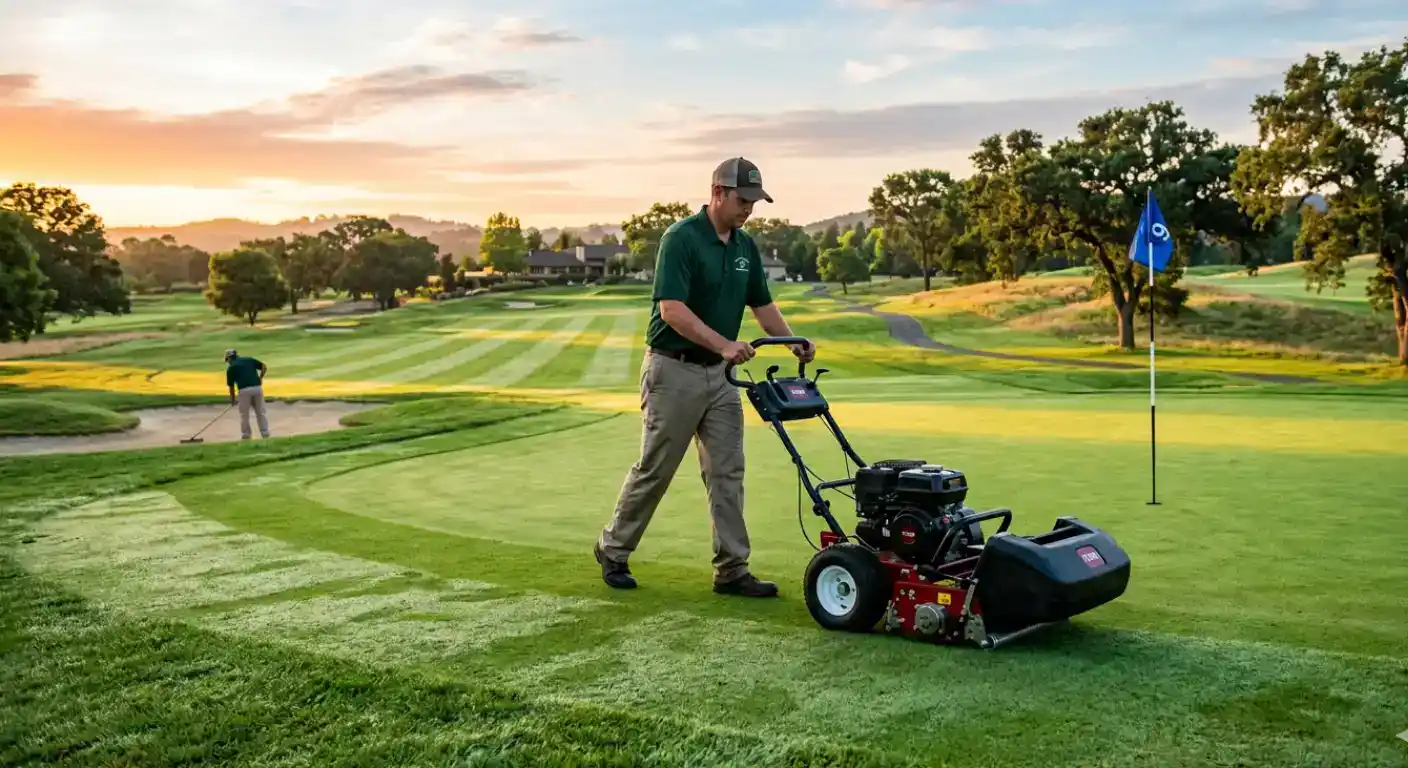
Beneath the essence of a modern golf facility; a landscape of sport and leisure, shaped by aesthetics and player experience, lies a far more technical environment, tooling systems for maintenance. Every fairway, green, and irrigation line depends on disciplined mechanical oversight, diagnostic accuracy, and tightly coordinated maintenance cycles. For operators and investors, long-term performance is increasingly determined not just by equipment quality, but by how effectively the supporting operational systems are structured at ground level.
Precision Maintenance Technology in Turf and Cutting Systems
Turf maintenance on a golf course is one of the most precise mechanical operations in outdoor engineering. Reel mowers do not cut grass in the conventional sense, they function as calibrated cutting assemblies where a rotating cylinder meets a fixed bedknife with extremely tight tolerances. Even microscopic deviation can affect turf health, drainage behavior, and disease resistance across entire playing surfaces.
This level of precision requires equally disciplined tooling systems. Instead of generic storage, maintenance teams depend on structured tool control environments that protect calibration integrity and prevent handling errors during repetitive adjustments.
In practice, technicians rely on controlled toolsets such as:
- Calibrated torque wrenches for reel alignment stability
- Precision feeler gauges for bedknife clearance control
- Grinding and sharpening tools maintained in strict sequence
- Fixed-position storage layouts to eliminate tool mix-up or loss
Modern tool box shadow foam systems that leverage bespoke CNC-cut layouts support this workflow by ensuring every tool has a defined, repeatable position. Even simple ergonomic enhancements such as lift-assisted removal points reduce handling delay and improve consistency during repetitive calibration tasks.
The result is not just organization, but operational stability across high-value turf systems where small errors scale quickly into costly surface degradation.
Golf Fleet Technology and Hybrid Mechanical-Electrical Tool Control
The golf cart industry has undergone a massive technological shift. If you look inside a modern fleet vehicle at a premium course like Gateway Hills or Fort Sam Houston, you aren’t looking at a simple mechanical utility cart anymore—you are looking at a highly sophisticated, high-efficiency vehicle that requires an equally technically aligned maintenance tooling system.
That shift has completely changed the demands placed on maintenance teams. Toolkits now need to support both mechanical repair and electrical diagnostics in a single structured system.
A structured toolkit for this environment typically includes:
- Heavy-duty mechanical sockets for chassis and drivetrain servicing
- Insulated hand tools for electrical safety compliance
- Digital multi-meters for system diagnostics and fault tracing
- Clearly separated storage zones for mechanical vs electrical equipment
When tool systems are poorly organized, hybrid maintenance becomes slower and less predictable. Errors increase, diagnostic time extends, and vehicle downtime directly impacts course operations.
Structured storage systems, particularly those designed around transport-ready cases and defined internal layouts, help maintain separation between tool types while ensuring technicians can transition seamlessly between electrical and mechanical tasks without hesitation or delay.
Irrigation Infrastructure Technology and Field-Level Diagnostic Tools
Beneath every golf course lies an extensive irrigation network: a concealed infrastructure of pipes, valves, pumps, and digitally controlled sprinkler systems. This network operates as a dynamic pressure-managed system designed to maintain consistent turf conditions across changing weather and usage patterns.
When faults occur, technicians are often working in exposed, time-sensitive field conditions where accuracy and speed are equally critical.
Typical field requirements include:
- Multi-meters for solenoid and circuit diagnostics
- Valve box wrenches designed for high-pressure systems
- Wiring and repair tools for on-site electrical corrections
- Portable, fully structured kits for remote access work
In this context, tool control becomes a reliability factor. A missing component does not simply delay a repair, it can extend water loss, damage turf consistency, or create uneven playing conditions across large areas of the course.
Well-structured mobile tool storage systems ensure technicians can operate independently in the field, completing interventions efficiently without returning to base for missing tools or replacement equipment.
Operational Discipline through Custom Tool Storage Systems
Across all golf-related maintenance operations like turf, fleet, or irrigation, one operational truth remains consistent: tool control directly affects asset protection. A single misplaced item on a fairway can cause mechanical damage worth tens of thousands, particularly when heavy turf machinery is in operation.
That is why leading golf facilities are increasingly adopting structured visual tool control systems as part of their operational framework rather than as an optional workshop upgrade.
Modern tool display and storage systems are built around clear principles:
- Fixed-position tool mapping for instant visual inventory checks
- High-contrast foam layers that immediately highlight missing items
- Optional tool coding for tracking and procurement alignment
- Workshop-to-field consistency for predictable technician performance
In practice, such creates a self-auditing system. Technicians can verify completeness in seconds before deployment, reducing risk while improving accountability across teams and shifts. For management, the value is operational predictability with fewer delays, fewer repeat visits, and more consistent service delivery across all maintenance functions.
In essence, the operational strength of a modern golf facility is increasingly defined by systems that sit behind the visible course experience. In high-performance golf operations, reliability is shaped long before equipment reaches the course. The discipline embedded in tool control systems quietly defines maintenance quality, asset longevity, and service continuity. Golf facilities that invest in structured technical organization of tool-kits gain more than efficiency: they gain stability across every operational layer that keeps the course running.