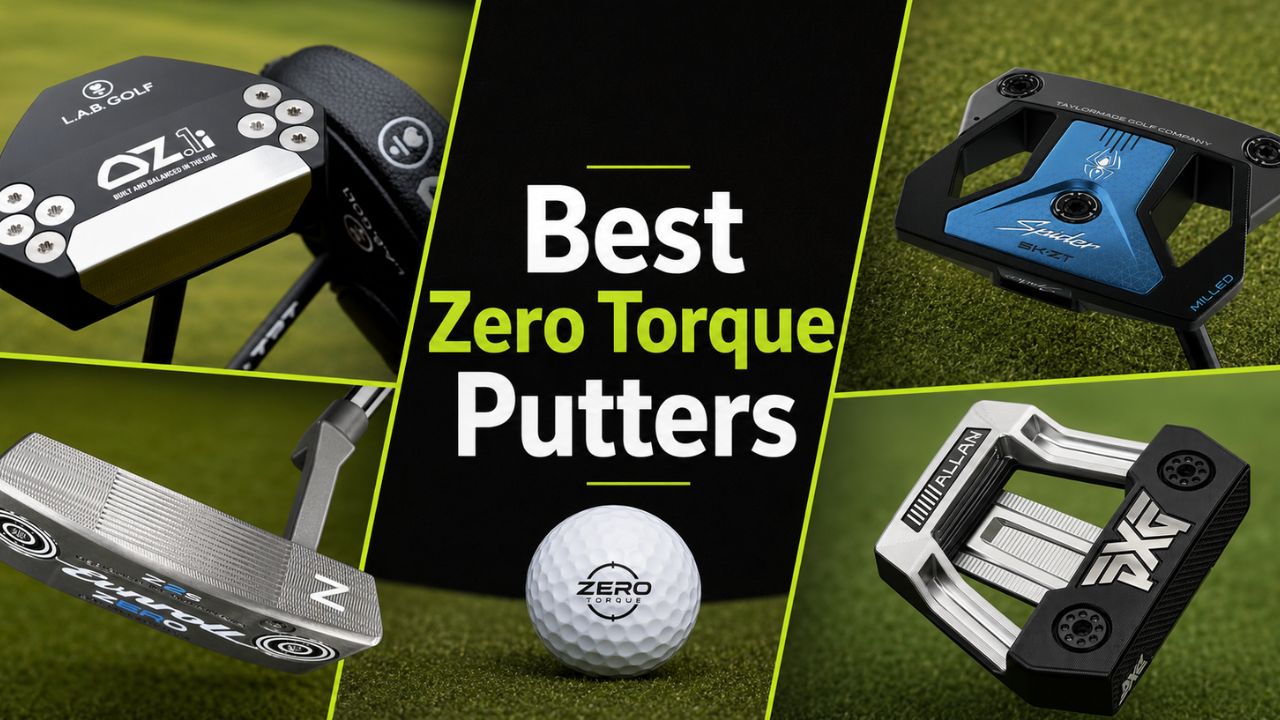
You line up the putt. You trust your read. And yet, the ball drifts off-line at the last second. Sound familiar? That tiny wobble usually isn’t your read at all. It’s your putter face twisting during the stroke. This is exactly the problem zero torque putters were built to solve.
Over the past couple of years, this category has quietly become one of the biggest shifts in putter design. What started as a niche idea from a small startup is now something every major brand offers. Golfers who once blamed their read or their nerves are now realizing the real issue was happening in their hands the entire time.
In this guide, you’ll get the top 10 zero torque putters, real prices, and a plain-English explanation of how each one keeps your face square. We’ll also walk through how to match a model to your stroke type, your budget, and your feel preference. By the end, you’ll know exactly which model fits your game without needing to test all ten in person.
What Does “Zero Torque” Actually Mean?
It is as follows in its plain form. All putters possess some amount of torque or, in technical terms, that is, twist. As you are making the stroke, your hands are moving, and your head is inclined to move either open or closed. The slightest twist will send your ball out of the line you meant, even at shorter putts, since a tiny error doubles the distance.
Zero torque putters combat this twist using intelligent design. Others have angled shafts. Others use either extreme perimeter weighting or special face inserts. Some are a combination of two or three of these approaches. Whatever the exact procedure, the aim remains the same with all brands. Your action with your hands of hitting on the face will keep it square on the impact even without having perfect control.
This is important as a majority of golfers do not possess textbook-perfect strokes. Touring players have hours of fine-tuning their mechanics, which is often not the case with weekend golfers. Instead of requesting you to correct years of muscle memory, these putters merely take the twist out of the equation. That translates to fewer pulling putts, fewer pushing putts, and more balls following the line you want.
Quick Comparison: Top 10 Zero Torque Putters and Prices
Before we break down each model in detail, here’s a fast side-by-side view so you can compare pricing and features at a glance.
| Rank | Putter Model | Price (USD) | Standout Feature | Best For |
| 1 | Odyssey Ai-Dual S2S #7 | ~$350 | Two-layer urethane insert | Consistent speed on mishits |
| 2 | TaylorMade Spider 5K ZT | ~$450 | Off-axis center shaft | Mallet stability seekers |
| 3 | L.A.B. Golf OZ.1i | ~$500 | Lie Angle Balance tech | Total torque elimination |
| 4 | Bettinardi Antidote SB2 | ~$450 | Milled-face precision | Boutique, premium feel |
| 5 | Wilson Infinite ZT (606) | ~$200 | MIM construction | Budget-conscious buyers |
| 6 | Sub 70 011-SQ | ~$229 | Perimeter weighting | Forgiveness on mishits |
| 7 | Vice Golf VGP03 ZT | ~$199 | Hands-free geometry | Simple, modern setup |
| 8 | Lazrus Golf LAZ2 | ~$217 | High-MOI mallet build | Mid-handicap accuracy |
| 9 | Evnroll Z2s | ~$399 | Progressive groove tech | Distance control issues |
| 10 | PXG Allan | ~$399 | Deep center of gravity | Crisp, responsive feel |
Now let’s look closely at what makes each one worth considering, and why it earned a spot on this list.
The Premium Picks: Built for Serious Players
L.A.B. Golf OZ.1i (Around $500)
This model essentially gave rise to the entire trend of zero torque putters. The Angle Balance system patented by L.A.B., helps to prevent twisting of the head and does so regardless of the grip you apply to it and the inconsistency of your hands over the stroke. Most teachers consider this to be the gold standard of zero-torque putters and it tends to be the first model suggested to golfers with difficulty in turning the face.
Its unusual design is appealing to the eye, at first sight because it has a unique bending shaft and a broad head. Nonetheless, that shape has a particular engineering explanation instead of style per se. After golfers get over the visual difference, most will observe a true increase in the frequency of their putts beginning on line. And in case you can afford it, this is the safest and the most confirmed in the entire list.
TaylorMade Spider 5K ZT (Around $450)
TaylorMade took its already popular Spider shape and tilted the center shaft one degree off-axis. That small change keeps the toe upright throughout your stroke, which physically limits how far the face can rotate. As a result, the face resists opening or closing on the way through, giving you a more repeatable strike.
This putter also benefits from TaylorMade’s existing reputation for forgiveness on off-center hits. So golfers who already trust the Spider lineup can upgrade to this zero torque version without adjusting to a completely new feel. It bridges familiar comfort with newer technology, which makes the transition easier for longtime Spider users.
Bettinardi Antidote SB2 (Around $450)
Need a global outlook with local performance? This is what is served in one package in this milled mallet. The weight is placed in the correct place where it should be and, therefore, the face remains square even during off-center blows. Even in this zero torque model, Bettinardi has developed a reputation based upon precision milling and that artisanship transfers to the present model.
This one draws the attention of feel-oriented players since it does not compromise on the soft, buttery feel on which Bettinardi putters are known to be. This design continues to impress many golfers who disapprove of the appearance of larger mallets, as they retain a more classy appearance before larger ones.
Mid-Range Options That Punch Above Their Price
Odyssey Ai-Dual S2S #7 (Around $350)
The artificial intelligence that Odyssey applied in developing a two-layer urethane insert is used to standardize ball speed in the whole face. A heel or toe strike won’t end up costing you much distance, hence a common problem with traditional putters. Of all the zero torque putters in this list, this one is the most balanced in the combination of modern technology and the classic feel.
The fang-shaped head also provides the golfers with good visual feedback of alignment, a good match to the matching torque-resistant construction below. It is a good, balanced alternative to other players that need a good performance without venturing into high-end prices.
Evnroll Z2s (Around $399)
The grooves used by Evnroll are literally pulling the ball back on your target line on off-centre hits and correcting for mishits, something most putters can do very little. This putter has a zero-torque hosel and forgives better than most of their counterparts at that price. In case your distance control was one of your vices, this design is aimed specifically at this particular problem.
Evnroll has developed fewer yet devoted follower golfers who put more emphasis on technology rather than tradition. This model is a mirror image of the philosophy: a combination of groove science in one head and torque resistance.
PXG Allan (Around $399)
PXG moved the center of gravity far behind the face with an exclusive shaft attachment that makes the difference in appearance between this item and the rest of the list. That arrangement produces very solid stability and a crisp-reacting sound when hit off that is pleasing to many golfers. It is also among the most recognisable-looking putters in this entire range, and this is attractive to golfers who wish to have equipment to showcase.
In addition to the aesthetic, the intense CG position actually serves to keep the face square with the stroke. This renders it a valid performance choice, rather than a putter that was selected because of its rather distinct look.
Budget-Friendly Zero Torque Putters
Wilson Infinite Zero Torque (Model 606) (Around $200)
Don’t judge this one by its price tag. Wilson uses precision molding and a double-milled face to control rotation effectively, offering technology that used to be limited to premium brands. For golfers who are curious whether zero torque putters actually make a difference, this is a low-risk way to find out without spending hundreds of dollars.
Wilson has historically focused on affordable, accessible equipment, and this putter continues that tradition. It’s a smart starting point for anyone new to the category.
Sub 70 011-SQ (Around $229)
This square-shaped mallet pushes mass toward the extreme edges of the clubhead, creating a distinctive boxy look. That design boosts forgiveness significantly, especially on mishits near the heel or toe. Sub 70 has built its reputation on direct-to-consumer value, cutting out retail markups to offer performance normally reserved for pricier brands.
Golfers who mishit putts frequently often find this model especially helpful, since the extreme perimeter weighting minimizes distance loss on imperfect strikes.
Vice Golf VGP03 ZT (Around $199)
Vice designed this putter around natural hand positioning rather than complex internal engineering. Simply gripping it the right way helps square the face automatically, without requiring any conscious adjustment during your stroke. It’s sleek, modern, and one of the most affordable zero torque putters worth trying.
Vice has built its brand around clean, minimalist design, and this putter reflects that aesthetic while still delivering genuine torque resistance.
Lazrus Golf LAZ2 (Around $217)
This forgiving mallet focuses on medium-length putts specifically, which are often the trickiest distance for amateur golfers. Its face-balanced, zero-torque setup helps newer golfers keep the ball tracking online throughout the stroke. For the price, few putters offer this level of forgiveness combined with genuine torque control.
Lazrus has grown a strong following among golfers looking for tour-level features without tour-level pricing, and this model fits squarely into that value category.
How to Choose the Right One for Your Stroke
Not every golfer needs the same setup, so use this quick breakdown to narrow your options before making a purchase.
- If you tend to push or pull putts: Try high-MOI mallets like the Sub 70 011-SQ or Lazrus LAZ2, since their weighting helps resist unwanted rotation.
- If you want a premium, boutique feel: Bettinardi and L.A.B. Golf lead this space with refined craftsmanship.
- If budget is your priority: Wilson and Vice both deliver strong value without sacrificing core technology.
- If distance control is your struggle: Evnroll’s groove technology was built specifically to correct that issue.
Also, consider shape before price, since comfort often matters more than raw specs. Testing a few zero torque putters in person will always give you a clearer sense of what feels natural in your hands compared to reading specs online.
Blade vs Mallet: Which Style Fits You?
Blade putters are typically suited to golfers who swing with an arcing stroke, as the smaller head balances a more rotating swing by hitting the ball. Mallets on the other hand are more applicable to players whose back-and-forth movement is straight, providing greater stability throughout the application.
The majority of the zero torque putters are inclined towards mallet-style designs, as the bigger head can distribute the weight more efficiently to resist torque. However, other designs, such as the Odyssey Ai-Dual, retain a more traditional profile used by golfers desiring the more traditional appearance but with the added benefit of the use of modern torque fighting technology under the hood.
Why Zero Torque Technology Keeps Growing in Popularity
A few years back, this category barely existed outside a handful of niche brands like L.A.B. Golf. Today, nearly every major manufacturer, including Odyssey, TaylorMade, and PXG, has released its own version. This shift happened gradually as golfers realized that face rotation, not just poor alignment or bad reads, causes many missed putts.
Consequently, demand for zero torque putters has expanded across every price range, from entry-level options under $250 to tour-quality models near $500. Instructors have also started recommending this category more often, which has accelerated adoption among everyday golfers looking for a simple equipment upgrade.
Final Thoughts
Choosing the right putter really comes down to your stroke, your feel preference, and your budget. Whether you pick the premium L.A.B. Golf OZ.1i or the budget-friendly Vice VGP03 ZT, each model on this list tackles the same core issue: unwanted face rotation. At the end of the day, zero torque putters give golfers at every skill level a simpler, more reliable way to keep their stroke consistent, and that consistency often makes the real difference on the scorecard.
Also Read About: Best Golf Bags 2025: Top 6 Picks Compared
FAQs About Zero Torque Putters
- Do zero torque putters actually improve accuracy?
Yes, for most golfers. They reduce face rotation, which is a leading cause of missed putts.
- Are zero torque putters good for beginners?
Definitely. Models like the Wilson 606 and Vice VGP03 offer solid forgiveness at an affordable price.
- What’s the typical price range for these putters?
Prices usually run from around $199 to $500, depending on materials and brand reputation.
- Is L.A.B. Golf considered the best zero torque brand?
Many golfers and instructors view it as the industry leader, thanks to its patented Lie Angle Balance system.
- Do these putters suit both blade and mallet preferences?
Mallets dominate this category, though a few blade-style options exist for traditional players.
- Can a zero torque putter completely fix a bad stroke?
Not entirely. No single club fixes everything, but it can significantly reduce errors caused by face twisting.
- Are budget-friendly zero torque putters actually worth buying?
Yes. Brands like Sub 70 and Lazrus offer strong performance without demanding a high price tag.
- How do I figure out which model fits my stroke?
Test a few in person, and pay attention to whether you tend to push, pull, or mishit putts often.