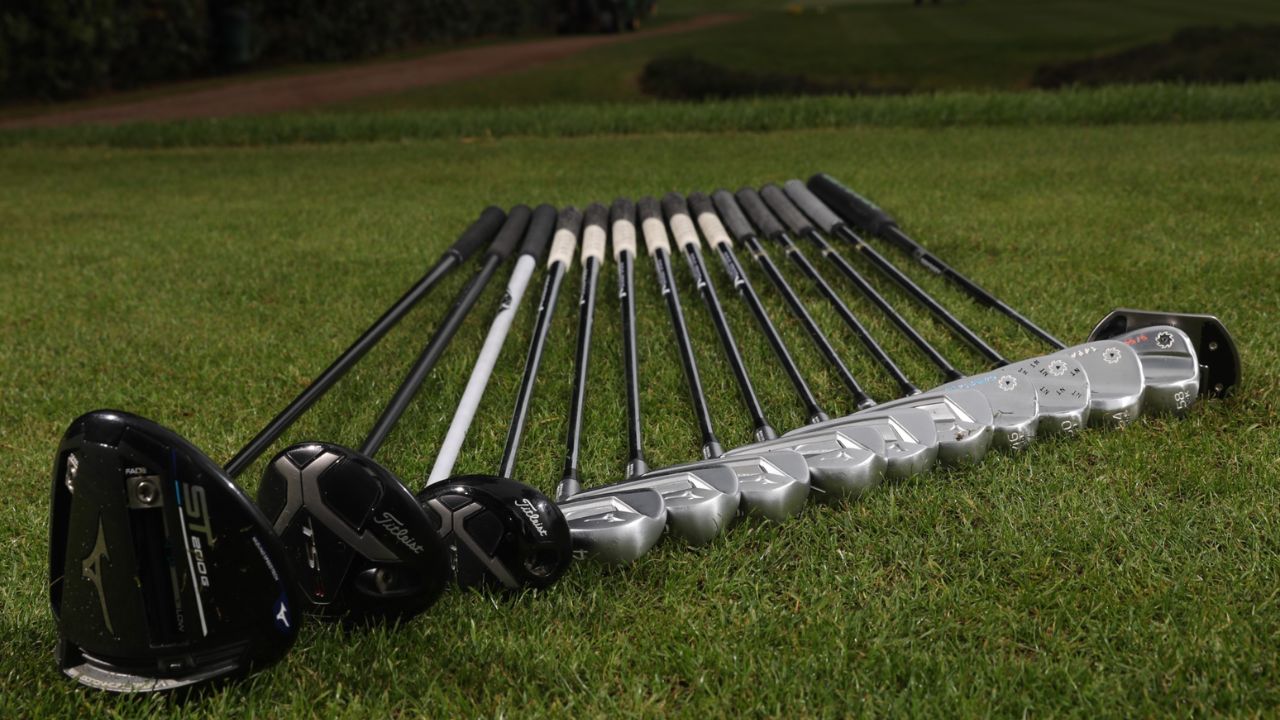
How many golf clubs in a bag are you allowed to carry? The answer is up to 14. This is the maximum set by the USGA and R&A under Rule 4.1b. There’s no minimum, so you can play with fewer than 14 if you want, and many golfers do. This guide explains the rule, why 14 is the number, walks through every club in a full set, covers shafts and fitting, and answers the questions beginners ask most.
How Many Golf Clubs in a Bag Are You Allowed to Carry?
The maximum is 14 clubs. This comes from the USGA and the R&A, the two governing bodies of golf, and it’s written into the official Rules of Golf under Rule 4.1b.
There’s no minimum requirement. You could technically play a round with three clubs if you wanted to. Most golfers don’t, because fewer clubs means fewer options for different distances, trajectories, and lies.
Why 14 Clubs? A Quick Look at the Rule
The 14-club limit dates back to the 1930s. Before it existed, some professional golfers carried 20, 25, even 30 clubs in a round, each one built for a very specific yardage or lie. That slowed play to a crawl and turned equipment budget into a competitive advantage, since wealthier players could simply buy more specialized clubs.
The USGA introduced the 14-club cap in 1938, and the R&A adopted it a year later. The number itself wasn’t scientific. It was a compromise that felt generous enough to cover every type of shot without making bags unmanageable. Nearly a century later, it’s still the standard at every level of the game, from a Tuesday afternoon nine-holer to the majors.
What happens if you carry more than 14?
Under Rule 4.1b, the penalty in stroke play is two strokes for each hole where the violation occurred, up to a maximum of four strokes for the round. In match play, it’s a loss of hole for each hole affected, capped at two holes. You’re expected to declare any excess clubs out of play, or remove them, as soon as you discover the error.
Do You Need All 14 Clubs in Your Bag?
Not necessarily, Plenty of golfers, including low-handicap players, carry 12 or 13 clubs and never feel like they’re missing anything.
Your swing speed plays a big role here. If your clubhead speed is on the lower side, several clubs can end up producing nearly identical carry distances. A 4-iron and 5-iron might land within a few yards of each other, for example. In that case, one of them isn’t adding value. It’s just taking up space and a decision point you don’t need mid-round.
A smarter approach is to build a bag around clubs you actually hit consistently, not one that hits the 14-club cap just because the rules allow it. A tighter, well-understood set almost always outperforms a full set of clubs you rarely practice with.
The Standard 14-Club Setup Explained
Most complete bags follow a similar formula. Here’s a breakdown of what a full setup typically includes.
| Club Type | Quantity | Best Use | Typical Loft Range |
| Driver | 1 | Long tee shots | 8-12 degrees |
| Fairway Woods | 1-2 | Distance from the fairway or tee | 13-21 degrees |
| Hybrids | 1-2 | Easier alternative to long irons | 17-27 degrees |
| Irons | 5-7 | Mid-range and approach shots | 20-45 degrees |
| Wedges | 2-3 | Short, high-loft shots near the green | 46-60 degrees |
| Putter | 1 | Rolling the ball on the green | 2-4 degrees |
This combination covers nearly every distance and situation you’ll face during a round. Beginners don’t need to fill every slot right away. It’s completely normal to grow into a full set over a season or two, as you learn which gaps in your yardages actually matter.
The Driver
The driver is built for maximum distance off the tee and has the lowest loft of any club in the bag, typically 8 to 12 degrees. This combines with a long shaft and large clubhead to maximize ball speed. Modern drivers also come with adjustable hosels, letting you tweak loft and face angle by a degree or two to correct a slice or hook without buying a new club.
Fairway Woods
Fairway woods, like a 3-wood or 5-wood, handle long shots when the driver feels too aggressive, or when your ball sits in the fairway and you still need serious distance. Higher-lofted fairway woods (7-wood, 9-wood) are increasingly popular with beginners and higher-handicap players because their shallow, wide soles make it much easier to get the ball airborne from the turf.
Hybrids
Hybrids blend the forgiveness of a wood with the control of an iron. Their lower center of gravity and wider sole make them one of the easiest clubs for beginners to launch, especially compared to long irons like a 3-iron or 4-iron. Many golfers now replace their entire long-iron set (3-iron through 5-iron) with two or three hybrids.
Irons
Irons cover the middle of your bag, usually numbered 4 through 9, plus a pitching wedge. They’re your go-to clubs for approach shots into the green. Iron sets generally fall into two categories:
- Cavity-back (game-improvement) irons, hollowed out behind the face to redistribute weight to the perimeter, making off-center hits more forgiving. Best for beginners and mid-handicappers.
- Blade (muscle-back) irons, a solid, compact head favored by better players who want more feedback and shot-shaping control, at the cost of forgiveness on mishits.
Wedges
Wedges handle short, high-loft shots close to the pin. Most bags carry at least two: a pitching wedge and a sand wedge. See the dedicated wedge section below for a full breakdown.
Putter
The putter is the only club used almost exclusively on the green. Precision and feel matter far more than power here, which is why putters vary so much in head shape (blade vs. mallet), weighting, and alignment aids. It’s often the most personal club-fitting decision in the bag.
What’s the Best Club for a Beginner to Start With?
If you had to choose just one club to learn golf with, a 7-iron is the smart pick. It’s not too long to feel intimidating off the tee or the turf, and it’s not too short to feel limited on distance.
A 7-iron works for longer approach shots, and it also handles bump-and-run shots around the green. That versatility, combined with a moderate amount of loft that helps get the ball airborne without much technique, makes it one of the best teaching clubs in golf. Many coaches build a beginner’s entire first lesson around the 7-iron before introducing the driver or wedges.
What Clubs Should a Beginner Golfer Carry?
A beginner bag doesn’t need to be complicated. Focus on the essentials first, then build from there as you identify real gaps in your game.
- A driver or 3-wood for tee shots
- A hybrid or two for long approach shots
- A handful of mid-irons (6-iron through 9-iron)
- A pitching wedge
- A sand wedge
- A putter
That’s roughly 8 to 10 clubs, plenty to play a full round and learn the game without decision fatigue on every shot. Many golf instructors recommend adding the hybrid early, since it’s forgiving, easy to launch, and often becomes a beginner’s most trusted club within a few rounds.
Do You Have to Carry All 14 Clubs?
No, Some golfers play for years with 12 or 13 clubs and never miss the extra slot. Adding a 14th club only makes sense if it fills a real, repeated gap in your distances, not just because there’s room in the bag.
Before adding another club just to reach the limit, think about what shot you’re actually missing. Track a few rounds. Are you consistently between clubs on approach shots? Struggling from bunkers? Missing a shot for the 100 to 150 yard range? If nothing comes to mind, your bag is probably already complete.
Do You Need a 3-Wood if You Already Have a Driver?
Not always, especially for beginners. A 5-wood or 7-wood can be a better alternative for long fairway shots, since higher-lofted fairway woods are noticeably easier to hit off the ground.
Hitting off a tee and hitting off the turf require two different skills. A traditional 3-wood has less loft and a shallower face, which demands a cleaner, more precise strike than a 5-wood or 7-wood. Beginners often find the higher-lofted options far more forgiving until their ball-striking becomes more consistent.
Are Hybrids Easier to Hit Than Long Irons?
Yes, hybrids are significantly easier to hit than long irons. Most beginners struggle with anything longer than a 5-iron or 6-iron because those clubs have very little loft and a thin, blade-like face that punishes anything but a clean strike.
Long irons demand more clubhead speed and a precise angle of attack to get the ball airborne. Hybrids solve that problem with a lower, more forward center of gravity and a wider sole that glides through turf rather than digging in, which makes mishits far more forgiving and gets the ball up in the air with much less effort.
How Many Wedges Should a Beginner Carry?
At minimum, carry two wedges: a pitching wedge and a sand wedge. Three wedges is even better if your bag has room, since it closes distance gaps in the scoring zone where most strokes are won or lost.
Wedge Comparison
| Wedge Type | Best For | Typical Loft Range | Typical Bounce |
| Pitching Wedge (PW) | Full and partial approach shots | 44-48 degrees | Low |
| Gap Wedge (GW/AW) | Filling the gap between PW and SW | 50-53 degrees | Low-Mid |
| Sand Wedge (SW) | Bunkers and thick rough near the green | 54-58 degrees | High |
| Lob Wedge (LW) | High, soft shots over hazards or tight pins | 58-64 degrees | Varies |
The pitching wedge is your go-to club for full approach shots into the green. The sand wedge, despite its name, does far more than bunker work. Its added bounce (the angle on the sole that prevents the club from digging in) and higher loft make it excellent for shots out of thick rough as well as sand.
When to Add a Gap Wedge or Lob Wedge
If there’s a noticeable distance gap between your pitching wedge and sand wedge, often 10 or more yards where a full swing with either club doesn’t line up cleanly, a gap wedge fills that space nicely. A lob wedge can come later, once you’re comfortable with the technique. Its high loft is unforgiving on a poorly struck shot and rewards a confident, committed swing more than raw power.
Can You Carry Two Putters in Your Bag?
Technically, yes. A second putter still counts toward your 14-club limit, so it’s allowed under the rules with no special exception.
That said, most golfers avoid it. Consistency is one of the most important parts of putting, and switching between two putters, even ones with slightly different lengths or head weights, makes that consistency harder to maintain. The rare exception is a long or “belly” putter carried alongside a standard one for specific green conditions, though this is mostly seen at the professional or serious amateur level.
Shaft Material and Flex: Does It Change How Many Clubs You Need?
Shaft choice doesn’t affect the 14-club limit, but it does affect how many clubs actually feel useful in your bag.
- Steel shafts are heavier, more consistent, and generally preferred in irons by players with faster swing speeds who want precise distance control.
- Graphite shafts are lighter and absorb more vibration, which helps generate clubhead speed. This is a common choice for drivers, fairway woods, hybrids, and increasingly for iron sets aimed at beginners or players with slower swing speeds.
- Shaft flex (extra stiff, stiff, regular, senior, ladies) should match your swing speed. Too stiff a shaft for your swing speed reduces distance and consistency. Too flexible can cause a loss of control on faster swings.
Getting fit for the right flex and material can sometimes let you play effectively with fewer clubs, since well-fit clubs perform more consistently and predictably across distances.
Building a Beginner Bag on a Budget
You don’t need to buy all 14 clubs new, or even all at once. A practical, budget-friendly path:
- Start with a half-set (8 to 10 clubs): driver or 3-wood, a hybrid, mid-irons (6-9), a pitching wedge, a sand wedge, and a putter.
- Buy secondhand or last-year’s models for anything beyond your core clubs. Driver and putter technology changes slowly enough that a 2 to 3 year old model performs nearly identically to new.
- Rent or borrow specialty clubs, like a lob wedge, before buying, to confirm you’ll actually use them.
- Get a basic fitting (many retailers offer this for free) even on a budget set. Correct shaft flex and length matter more for consistency than brand name.
- Add clubs as gaps appear, not on a fixed schedule. Let a few months of real rounds tell you what’s missing.
Does the Right Number of Clubs Change by Course or Conditions?
Yes, to a degree. This is why many golfers keep a couple of “swap” clubs at home rather than treating their bag as fixed.
- Tight, tree-lined courses: some golfers drop the driver for a 3-wood or hybrid off the tee to prioritize accuracy over distance, then add an extra wedge for the shorter approach shots that follow.
- Wide-open, links-style courses: an extra fairway wood or hybrid can be more useful than a second wedge, since long, rolling approach shots are more common.
- Wet or heavy rough conditions: a higher-bounce sand wedge becomes more valuable than a lob wedge, which performs poorly out of thick, wet grass.
None of this changes the 14-club maximum. It’s simply about which 14, or fewer, clubs you choose to carry that day.
Final Thoughts on How Many Golf Clubs in a Bag You Really Need
So, how many golf clubs in a bag do you actually need? Up to 14 is allowed, but your ideal number depends on your skill level, swing speed, and the gaps you actually notice in your own game. Beginners are better off starting with the essentials: a driver or 3-wood, a hybrid, a few irons, two wedges, and a putter, and adding clubs only when a real gap shows up in practice or on the course.
A well-built bag isn’t about hitting the 14-club limit. It’s about carrying clubs you trust, understand, and can hit consistently under pressure. Start simple, learn each club well, and let your bag grow naturally as your game does.
Also Read About: Cleveland ZipCore XL Iron Set: Honest Review & Verdict
FAQs: Golf Club Bag Rules
How many golf clubs in a bag are allowed during a round?
Up to 14 clubs, per official USGA and R&A rules under Rule 4.1b.
Is there a minimum number of clubs required?
No, You can play with fewer than 14 clubs with no penalty.
What happens if I carry more than 14 clubs?
A two-stroke penalty per hole in stroke play (max four strokes for the round), or loss of hole in match play (max two holes), under Rule 4.1b.
Can beginners play with fewer than 14 clubs?
Yes, Many beginners start with 8 to 10 clubs and add more as their game develops and specific distance gaps become clear.
What’s the most beginner-friendly club in a bag?
The 7-iron and hybrid clubs are usually the easiest for new golfers to hit consistently.
Do professional golfers always carry all 14 clubs?
Almost always, yes, At that level, every yardage gap matters, so touring pros typically fill all 14 slots and fine-tune the exact combination (like how many wedges vs. how many long irons) week to week based on the course.
Can I change which 14 clubs I carry between rounds?
Yes, You can swap clubs before a round starts, but once you begin play, you’re locked into whatever’s in the bag, or in reasonable reach, for that round.