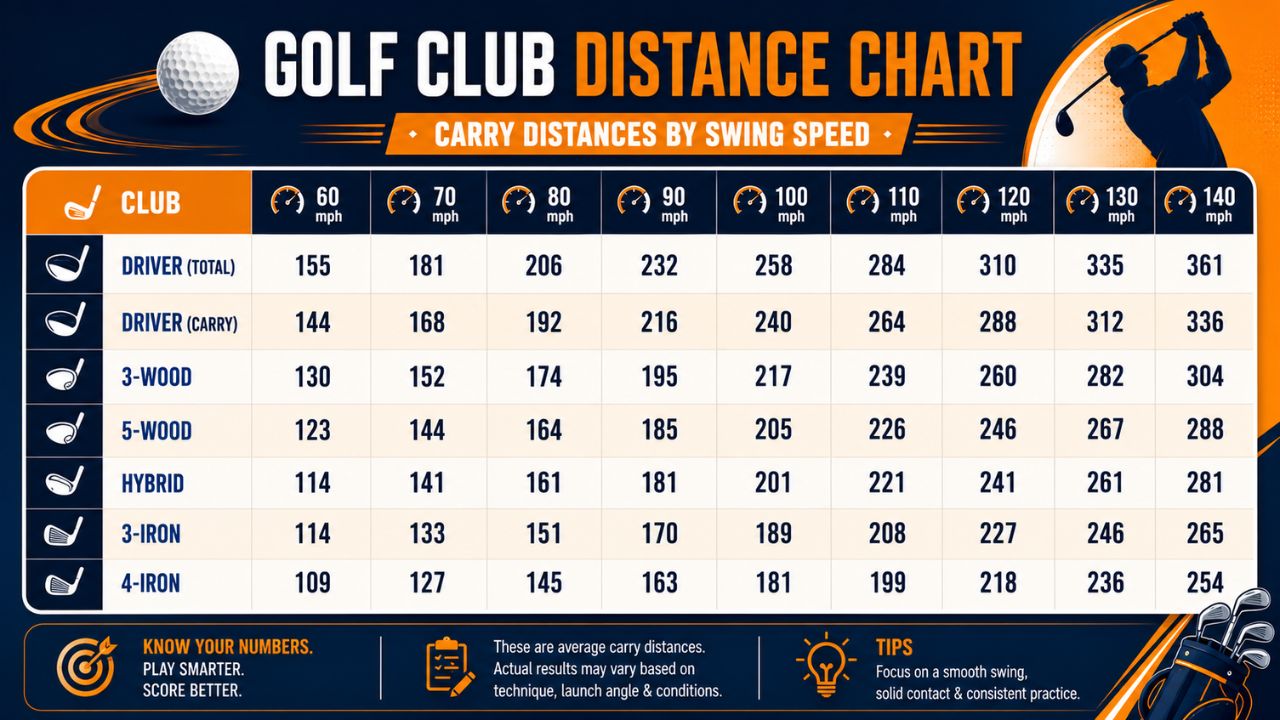
Ever stood on a fairway wondering if your 7-iron should really be going 150 yards? You’re not alone. Most golfers guess their distances instead of knowing them, and that single habit quietly adds strokes to every round. A reliable golf club distance chart removes the guesswork from club selection. It shows you what average, good, and elite golfers hit with each club, so you can measure your own game against real numbers instead of locker room bragging rights.
Distance obsession is common in golf. Everyone wants to hit it farther. But chasing yardage without understanding your actual numbers usually backfires. You end up misjudging approach shots, picking the wrong club under pressure, and leaving strokes on the course that had nothing to do with your short game.
In this guide, you’ll get a full breakdown by skill level, swing speed, gender, age, and PGA Tour averages. You’ll also learn why two golfers with identical swing speeds can produce wildly different distances, how modern equipment changed the entire distance conversation, and how to start building your own accurate golf club distance chart from scratch.
Why a Golf Club Distance Chart Matters More Than You Think
Golf is fundamentally a game of numbers. Every shot depends on matching the right club to the yardage sitting in front of you. Get that match wrong repeatedly, and your scorecard suffers no matter how good your swing looks.
Without a golf club distance chart, most players fall into one of two traps. Either they overestimate their power, based on that one incredible shot from three years ago, or they underclub out of habit and constantly come up short of the green. Both mistakes are expensive.
Overestimating leads to chunked approach shots, balls that never reach the target, and short-siding yourself into difficult up-and-downs. Underestimating leads to blown-out greens, three-putts from too far away, and wasted distance on shots that could have used one less club.
Knowing your real yardages, not your best-ever shot, is what separates confident ball-striking from constant second-guessing. A proper chart also helps you communicate better with a coach or fitter, since you can point to real data instead of vague impressions.
The Psychological Benefit of Knowing Your Numbers
There’s also a mental side to this. Golfers who trust their distances commit fully to their swing. Golfers who aren’t sure how far they hit a club tend to decelerate through impact, second-guess their club choice mid-swing, and produce worse contact as a result. Confidence in your numbers translates directly into better strikes.
Golf Club Distance Chart by Skill Level
Skill level changes almost everything about your distance profile. As technique improves, swing speed naturally rises, strike quality becomes more consistent, and every club in the bag starts traveling farther and more predictably.
Here’s how average yardages break down across four common skill tiers, based on typical recreational and competitive data.
| Club | Beginner | Average Golfer | Good Golfer | Excellent Golfer |
| Driver | 180 yds | 220 yds | 250 yds | 280 yds |
| 3 Wood | 170 yds | 210 yds | 225 yds | 235 yds |
| 5 Wood | 150 yds | 195 yds | 205 yds | 220 yds |
| Hybrid | 145 yds | 180 yds | 190 yds | 210 yds |
| 4 Iron | 100 yds | 160 yds | 170 yds | 195 yds |
| 5 Iron | 120 yds | 155 yds | 165 yds | 185 yds |
| 6 Iron | 120 yds | 145 yds | 160 yds | 175 yds |
| 7 Iron | 110 yds | 140 yds | 150 yds | 165 yds |
| 8 Iron | 100 yds | 130 yds | 140 yds | 155 yds |
| 9 Iron | 90 yds | 115 yds | 125 yds | 145 yds |
| Pitching Wedge | 80 yds | 100 yds | 110 yds | 135 yds |
| Sand Wedge | 55 yds | 80 yds | 95 yds | 115 yds |
Notice how the gap between clubs widens as skill improves. A beginner might hit their 5 iron and 6 iron almost identically, since neither club is launching correctly yet. A skilled golfer separates every club by a clean 10 to 15 yard gap, which makes club selection far easier under pressure.
Beginner Golfer (First 6-12 Months)
New golfers are still building consistent contact, and that inconsistency shows up everywhere in the chart. Long irons especially suffer, since low-lofted clubs punish anything but a solid strike. Distance gains at this stage come mostly from improving contact quality, not from swinging harder. In fact, beginners often lose distance by trying to swing faster before their fundamentals are solid.
Average Golfer (15-24 Handicap)
This is where most weekend players sit, and it’s also where the most improvement potential exists. Swing mechanics are developing, but center-face contact still isn’t consistent every time. A few lessons focused purely on strike quality, rather than power, tend to produce the biggest jumps in this bracket.
Good Golfer (6-14 Handicap)
At this level, swing speed and strike quality both start working together. Distance gaps between clubs become more predictable, and course management becomes far easier since the golfer can trust their numbers on more shots.
Excellent Golfer (Below 6 Handicap)
Once handicaps drop below single digits, swing speed and strike quality both improve together consistently. That combination is what pushes distance numbers up across the entire bag, not just the driver. Excellent golfers also tend to have tighter dispersion, meaning their shots land in a smaller area rather than scattering unpredictably.
Golf Club Distance Chart by Swing Speed
Swing speed is one of the biggest levers for distance, but it only tells half the story. Two golfers can share the exact same swing speed and still see a 20-yard difference in carry, depending on how cleanly each one strikes the ball.
Still, swing speed gives you a solid starting benchmark for estimating distance. Most recreational golfers swing the driver around 90 mph, while PGA Tour pros average closer to 114 mph. Long drive competitors can push well past 150 mph, though that represents the extreme top end of human swing speed.
| Club | 70 mph | 90 mph | 110 mph | 130 mph | 150 mph |
| Driver (carry) | 170 | 219 | 268 | 316 | 365 |
| 3 Wood | 150 | 195 | 238 | 283 | 318 |
| 5 Wood | 145 | 185 | 225 | 265 | 305 |
| Hybrid | 140 | 180 | 220 | 260 | 300 |
| 5 Iron | 120 | 155 | 185 | 215 | 247 |
| 7 Iron | 105 | 135 | 165 | 185 | 210 |
| Pitching Wedge | 85 | 110 | 135 | 156 | 179 |
If your driver swing speed sits around 90 mph, expect a carry distance close to 219 yards, assuming solid contact near the centre of the face. Slower or faster swings will shift every number in the chart up or down accordingly, and mishits will pull every number down regardless of speed.
Why Swing Speed Alone Doesn’t Guarantee Distance
It’s tempting to assume that adding swing speed automatically adds yardage. That’s only true if strike quality stays constant. A golfer who adds 10 mph of clubhead speed but starts missing the center of the face more often can actually lose distance, not gain it. Speed and contact quality have to improve together for the chart numbers above to actually apply to your game.
Average Golf Club Distances by Gender
Physiology plays a real role in swing speed, and that naturally shifts average distances between men and women across nearly every club in the bag.
| Club | Men’s Average | Women’s Average |
| Driver | 220-230 yds | 150-180 yds |
| 3 Wood | 195-210 yds | 140-170 yds |
| 5 Wood | 185-195 yds | 130-160 yds |
| Hybrid / 4 Iron | 165-180 yds | 120-150 yds |
| 5 Iron | 155-170 yds | 110-140 yds |
| 7 Iron | 135-150 yds | 90-120 yds |
| Pitching Wedge | 100-115 yds | 60-90 yds |
These ranges reflect averages, not limits. Plenty of women outdrive plenty of men, and dedicated swing speed training can shift these numbers significantly over time for any golfer, regardless of gender.
Swing Speed by Age and Gender
Age also affects swing speed, mostly through gradual changes in flexibility, muscle mass, and joint mobility over time.
| Age Group | Men | Women |
| 10-16 years | 93 mph | 83 mph |
| 17-29 years | 113 mph | 93 mph |
| 30-50 years | 103 mph | 85 mph |
| 50-60 years | 99 mph | 74 mph |
| 60+ years | 93 mph | 73 mph |
Interestingly, swing speed peaks in the late twenties for most golfers, then gradually declines through the following decades. That’s exactly why mobility and strength training become more valuable as golfers age. Golfers who stay active in the gym often retain significantly more swing speed into their fifties and sixties compared to those who don’t train at all.
Why Junior Golfers Sometimes Outswing Adults
It might look surprising that 10 to 16 year olds average close to adult swing speeds in some cases, but this usually comes down to modern coaching methods. Junior golfers today often receive proper mechanics training earlier than previous generations did, which helps them generate efficient speed even without significant strength.
PGA Tour Distances vs Everyday Golfers
It helps to see where amateur numbers stack up against the professionals. The gap is bigger than most people expect, even for genuinely strong recreational players.
| Club | PGA Tour Average | Good Amateur | Average Amateur |
| Driver | 275-300+ yds | 250 yds | 220 yds |
| 3 Wood | 243-260 yds | 225 yds | 210 yds |
| 5 Wood | 230-240 yds | 205 yds | 195 yds |
| 5 Iron | 194-210 yds | 165 yds | 155 yds |
| 7 Iron | 165-180 yds | 150 yds | 140 yds |
| Pitching Wedge | 130-140 yds | 110 yds | 100 yds |
A 250 yard drive, for context, is genuinely solid for an amateur golfer. Data from shot-tracking platforms shows only around 15 to 31 percent of golfers reach that distance consistently. So if you’re already hitting it there, you’re ahead of most of the field, even if pros are hitting the same club 50 yards farther.
Why Pros Hit It So Much Farther
The difference isn’t purely swing speed. Tour professionals combine elite swing speed with near-perfect strike quality and equipment that’s custom fitted to their exact swing characteristics. A pro and an amateur swinging at identical speeds will still see the pro’s ball travel farther, purely because of contact quality and equipment optimization.
What Is Smash Factor and Why It Controls Your Distance
Swing speed gets most of the attention in golf conversations, but smash factor is arguably more important for actually predicting distance. It measures how efficiently your swing speed transfers into ball speed at the moment of impact.
The formula is simple. Ball speed divided by club speed gives you the smash factor number. A driver swing of 100 mph producing 150 mph ball speed gives you a 1.50 smash factor, which happens to be the tour-level benchmark for the driver specifically.
Ideal Smash Factor for Every Club
Smash factor actually decreases as club loft increases, since more loft naturally creates more backspin and slightly less efficient energy transfer at impact.
| Club | Ideal Smash Factor |
| Driver | 1.49 |
| 3 Wood | 1.48 |
| 5 Wood | 1.47 |
| Hybrid | 1.46 |
| 5 Iron | 1.41 |
| 7 Iron | 1.33 |
| 9 Iron | 1.28 |
| Pitching Wedge | 1.23 |
This is exactly why two golfers with matching swing speeds can post very different final numbers. Center-face contact makes an enormous difference, and improving it is often more valuable than adding raw swing speed through the gym alone.
How to Improve Your Own Smash Factor
Working with a coach who tracks your strike location is the fastest way to improve smash factor. Impact tape or spray on the clubface will show exactly where you’re making contact, and small adjustments to setup or swing path often produce immediate improvements in ball speed, even without changing swing speed at all.
Factors That Affect Your Golf Club Distance
Distance isn’t just about how hard you swing the club. Several variables combine together to determine your final yardage on any given shot, and understanding each one helps explain why your numbers change from round to round.
- Swing speed: Faster swings generally produce more ball speed and more total carry distance.
- Strike quality: Center contact transfers far more energy than a mishit, even at identical swing speeds.
- Equipment fitting: Properly fitted shafts and lofts help you use your natural swing speed more efficiently.
- Club loft: Lower lofts travel farther, but they also require more speed to launch the ball correctly.
- Weather conditions: Cold, dense air and wet turf both reduce total distance noticeably.
- Altitude and wind: Thinner air at elevation adds distance, while a strong headwind shortens it significantly.
- Ball compression: Colder golf balls compress less efficiently, which slightly reduces ball speed off the face.
How to Increase Your Swing Speed
If you’re chasing extra yards, there are really only three proven paths that consistently work for most golfers.
- Work with a swing coach: Proper mechanics alone can add up to 10 mph of clubhead speed without any change in strength.
- Train strength and mobility: A structured gym routine focused on rotational power can add another 10 to 20 mph over time, depending on your starting point.
- Get fitted for lighter equipment: Lighter shafts can add a modest but real 2 to 5 mph on their own, particularly for golfers with slower natural tempo.
Coaching tends to deliver the biggest overall return, mainly because it improves contact quality alongside raw speed at the same time. Speed without a center strike doesn’t translate into real distance gains, and can sometimes make your misses worse.
Carry Distance vs Total Distance: What’s the Difference
These two terms get mixed up constantly among recreational golfers, but the difference matters quite a bit for accurate club selection.
Carry distance is how far the ball travels purely through the air, before it makes contact with the ground. Total distance includes that flight plus any rollout after landing, which varies significantly depending on conditions.
For approach shots into greens, carry distance is what actually matters most. Rollout depends heavily on turf firmness, green speed, and how the ball lands, so it’s far less predictable than a clean airborne yardage number. This is exactly why serious golfers track carry distance specifically when building their personal golf club distance chart.
Why Rollout Varies So Much
A firm, dry fairway can add 15 to 20 yards of rollout to a driver shot. A soft, wet fairway might add almost nothing. This variability is precisely why carry distance, not total distance, should form the foundation of your club selection strategy on approach shots.
Why Modern Equipment Changed Everything
Golf clubs today look nothing like the clubs from even twenty years ago, and that shift shows up directly and dramatically in modern distance charts.
Lower Lofts Across the Board
A 7 iron from the 1990s often carried 39 to 41 degrees of loft. Today’s 7 iron sits closer to 36 to 38 degrees. That small change alone accounts for a noticeable jump in yardage for the exact same numbered club, which is why comparing distances across generations gets confusing quickly.
Lighter, Bigger Club Heads
Modern drivers use titanium and carbon fiber construction paired with graphite shafts. Compare that to the heavy steel and solid persimmon wood clubs used decades ago, and it’s easy to see why swing speeds and ball speeds both climbed so dramatically across the entire sport.
Golf Ball Technology
Modern urethane-covered golf balls fly straighter and spin less than the older balata balls once used on tour. That single change added real distance across every skill level, not just for touring professionals, and it’s part of why governing bodies are now discussing ball rollback rules.
Bigger Sweet Spots Mean More Forgiveness
Club heads have also grown significantly larger, which creates a bigger effective hitting area on the face. This means off-center strikes lose less distance than they used to, helping average golfers retain more yardage even on imperfect swings.
How to Find Your Own Stock Yardages
Charts are a useful starting point for comparison, but your personal numbers are what actually matter once you’re standing over a shot on the course.
Visit a simulator bay or rent a portable launch monitor and hit at least ten clean shots with each club in your bag. Average the carry distances together, ignore your best-ever swing from the group, and build your personal golf club distance chart from that realistic data set. A cheap rangefinder can also help you verify those numbers directly on the course over several rounds.
How Often Should You Retest Your Numbers
Distances change over time as strength, flexibility, and equipment change. It’s worth retesting your full bag at least once a year, or immediately after any swing changes, new club purchases, or significant fitness improvements.
How Much Yardage Gap Should Be Between Clubs
A well-built bag has consistent, predictable spacing between each club. Aim for roughly 10 to 15 yards of separation between every iron and wedge you carry, so there are no awkward distances where two clubs feel identical.
If two clubs in your bag are producing the same distance, something needs adjusting. That could mean your technique, your loft gaps between clubs, or simply how you’re gripping down on certain shots to manufacture different yardages.
Conclusion
A solid golf club distance chart gives you a real benchmark instead of a rough guess. Once you understand how skill level, swing speed, and smash factor all combine together, your own numbers start making a lot more sense on the course.
Don’t chase your best-ever shot as your personal baseline. Track your average carry distance for every single club, compare it honestly against the golf club distance chart above, and build a bag with clean, consistent gaps between clubs. That single habit will save you strokes far faster than chasing extra swing speed alone, and it will make every club selection decision noticeably easier under pressure.
Also Read About: How to Stop Topping the Golf Ball (Simple Fixes That Work)
FAQs
How do I find my exact club distances?
Visit a simulator bay or use a portable launch monitor, then hit ten clean shots per club and average the carry distance for each one.
What’s the difference between carry and total distance?
Carry is how far the ball flies through the air alone. Total distance adds the rollout that happens after it lands on the ground.
Why do two of my irons go the same distance?
Slow swing speed or inconsistent strikes can stop a lower-lofted iron from launching high enough to outcarry the club sitting above it.
How much gap should be between each club?
Aim for roughly 10 to 15 yards of separation between every consecutive club in your bag, from wedges through your longest irons.
Does cold weather really reduce distance?
Yes, Colder, denser air increases aerodynamic drag and can cut 2 to 5 yards off your total distance for every 10-degree drop in temperature.
Should I club based on my best shot ever?
No, always club based on your average distance rather than your personal best, or you’ll consistently come up short of your intended target.
Why do pros hit wedges so much farther than amateurs?
Tour players deloft the clubface at impact through refined technique, which creates better compression and noticeably higher ball speed.
Is a 250 yard drive considered good?
Yes, Shot-tracking data shows only about 15 to 31 percent of golfers reach that distance consistently, so it puts you ahead of most players.