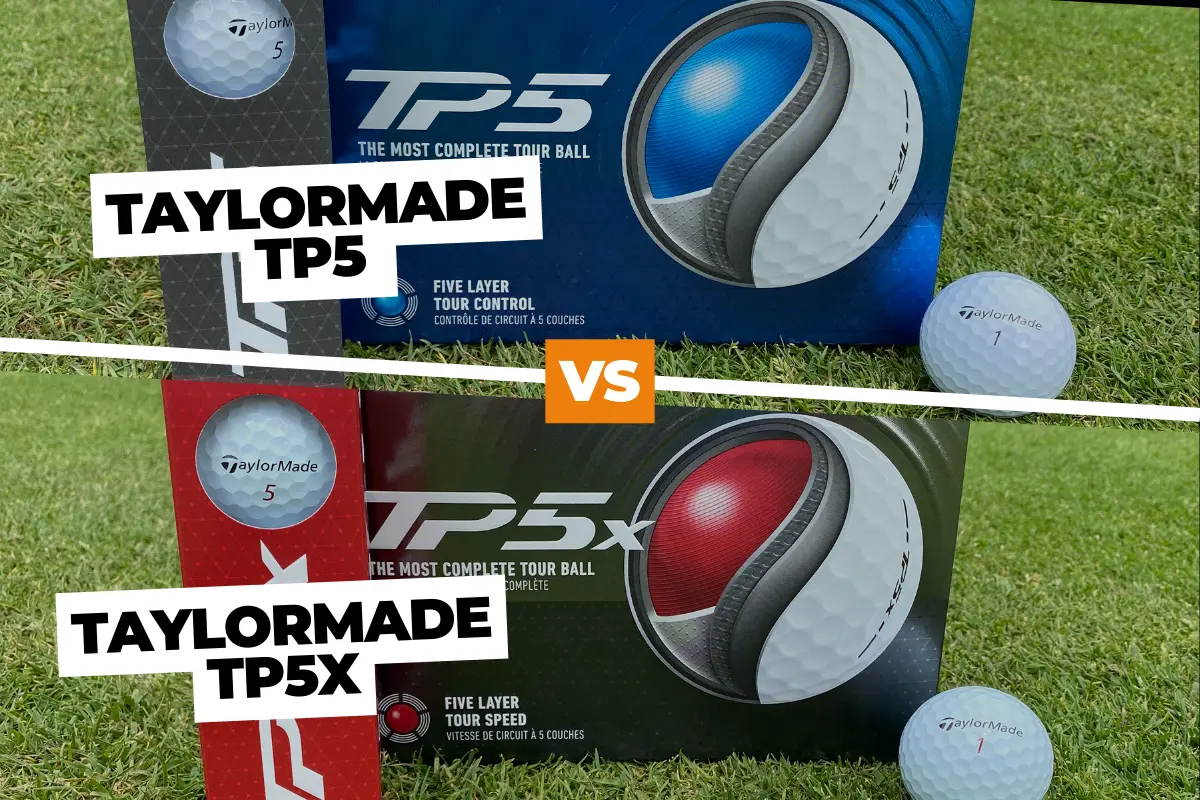
Picking between tp5 vs tp5x is one of the most common questions serious golfers ask, and honestly, it’s not a question with one universal answer. Two players with the exact same handicap can need two completely different balls, simply because their swing, strike pattern, and short game habits are different.
This comparison exists because both balls come from the same five-layer TaylorMade tour family, yet they’re built to solve opposite problems. One chases feel and control. The other chases speed and distance. Neither one is objectively superior. The real goal is figuring out which one quietly fixes your biggest miss without hurting the rest of your bag.
So before you buy a dozen based on what a tour pro plays, it helps to understand what actually separates these two balls from tee to green. Golfers often assume the decision is just about swing speed, but that’s only part of the story. Your strike location, your typical miss, your course conditions, and even how hard you practice your wedges all factor into which ball performs better for you.
This guide breaks it down shot by shot, so you can test smarter and choose with real confidence instead of guesswork.
The Complete TP5 vs TP5x Comparison
For golfers who want every detail side by side in one place, here’s the full breakdown covering feel, performance, and course behavior.
| Category | TP5 | TP5x |
| Compression | ~85-87 | ~97-102 |
| Feel | Soft, plush, muted | Firm, clicky, responsive |
| Construction | 5-layer, cast urethane cover | 5-layer, cast urethane cover |
| Dimple pattern | 322 seamless tour flight | 322 seamless tour flight |
| Driver spin | Higher | Lower, flatter flight |
| Driver distance | Standard tour distance | Maximum tour distance |
| Ball speed | Fast | Fastest |
| Launch window | Mid to low, penetrating | Higher overall launch |
| Long iron behavior | Slightly higher spin | Flatter, more stable |
| Mid iron consistency | Predictable release, more grip | Flatter flight, tighter dispersion |
| Wedge spin | Maximum, sticky control | Playable, more rollout |
| Greenside behavior | One-hop-and-stop | Checks then releases |
| Putting feel | Soft, muted sound | Firmer, sharper sound |
| Wind performance | Can balloon slightly | Handles wind better |
| Best for | Feel, control, short game | Speed, distance, flatter flight |
| Ideal player | Feel-focused, needs more spin | Speed-focused, needs flatter flight |
Why Layer Construction Changes How the Ball Behaves
Both balls use a five-layer build, but the tuning inside each layer is different. That matters because different clubs touch different parts of the ball, and each layer has its own job to do.
Your driver mostly compresses the inner core, so that’s where launch and overall spin get shaped. Also, Your irons rely on the middle layers, where consistency between shots matters more than raw numbers. Your wedges barely touch the core at all. Instead, they grip almost entirely through the outer cover, which is why cover material plays such a huge role in short game feel.
Because of this layered approach, TaylorMade can tune each ball differently without redesigning the entire product from scratch. A small shift in core firmness or cover thickness can completely change how a shot behaves, while leaving every other part of the ball’s performance untouched. This is exactly why tp5 vs tp5x produces such distinct outcomes even though both share the same five-layer philosophy.
| Club Type | Layer Involved | What It Controls |
| Driver | Inner core | Launch angle and overall spin |
| Long irons | Mid layers | Speed retention and trajectory |
| Short irons | Mid to outer layers | Spin consistency and release |
| Wedges | Outer cover | Friction, grip, and stopping power |
| Putter | Cover and core combined | Feel and sound at impact |
Feel and Compression: The First Thing You’ll Notice
Compression is usually the first difference golfers feel, often right on the putting green before they’ve even hit a full shot. It’s the kind of difference you notice within a few putts, long before you start analyzing spin numbers or launch angles.
TP5 sits lower on the compression scale, which gives it a soft, plush strike that many golfers associate with premium tour balls. TP5x sits higher, producing a firmer click and more immediate feedback off the face. Some players interpret that firmness as more “responsive,” while others simply prefer the muted sound of a softer ball.
Neither is right or wrong here. It genuinely comes down to preference, putting stroke feel, and how sensitive your hands are to feedback at impact. Some golfers even choose based purely on sound, since a ball that “feels wrong” off the putter can quietly affect confidence over 18 holes.
| Compression Factor | TP5 | TP5x |
| Compression rating | ~85-87 | ~97-102 |
| Sound off putter | Muted, soft | Sharper, more responsive |
| Feel off irons | Plush | Crisp |
| Feedback | Subtle | Immediate |
Driver and Long Iron Performance
This is where a lot of golfers quietly lose or gain distance without realizing why, since driver performance depends on more than just how fast you swing.
TP5x tends to shed spin off the driver and long irons, which helps produce a flatter, more piercing ball flight. That flatter window often adds total yardage, especially in windy conditions where excess spin usually punishes distance the most. TP5, on the other hand, launches slightly higher with a touch more spin, which can help golfers who already struggle to keep the ball airborne or who need extra carry to clear trouble.
It’s worth noting that spin isn’t automatically bad. Some golfers actually need a bit more spin to keep the ball in the air long enough to maximize carry distance. The key is matching spin level to your specific swing characteristics rather than assuming lower spin always means longer drives.
Here’s a pattern worth remembering. Golfers who tend to balloon their drives in the wind often benefit from testing TP5x. Golfers who hit low, diving shots that don’t carry far enough often see better results with TP5.
| Miss Pattern | Likely Better Fit | Reason |
| Ballooning drives in wind | TP5x | Lower spin, flatter flight |
| Low, diving drives | TP5 | Slightly higher launch |
| Inconsistent long iron carry | TP5x | Flatter, more stable window |
| Struggling to hold the green with irons | TP5 | Softer landing, more spin |
Impact Location Matters More Than People Think
Two golfers with identical swing speeds can need completely different balls, and here’s why this often gets overlooked.
If you consistently strike high on the clubface, you naturally produce lower spin and higher launch already, even before factoring in ball selection. If you strike low on the face, you tend to add spin and reduce launch, which changes what the ball needs to compensate for. So your strike pattern can matter just as much as your raw swing speed when deciding between tp5 vs tp5x.
This is one of the most underrated parts of ball fitting. Two players with the same 95 mph swing speed can end up needing opposite balls simply because one lives high on the face and the other catches it low. That’s why swing speed alone should never be the only factor in your decision.
Fairway Woods and Long Irons: Holding Greens From Distance
Bombing your driver doesn’t help much if your 5-wood or long iron releases 20 feet past the pin. This is where a lot of distance-focused golfers quietly lose strokes without realizing it, since a great tee shot means little if your next shot rolls off the back of the green.
Fairway wood and long iron performance is really about balance. You want enough height to hold the green, but not so much spin that the ball loses distance or gets pushed around by wind. TP5 and TP5x approach this balance from opposite directions, which is why testing both with your actual long clubs matters more than testing with just a driver.
| Category | TP5 | TP5x |
| Spin | Slightly higher | Lower |
| Peak flight | Higher | More penetrating |
| Green hold | Softer landing | More rollout |
| Ideal for | Extra control into greens | Distance and stability |
If your long approach shots land and keep rolling, TP5 is worth a test round. If they already fly high and stall out awkwardly, TP5x may smooth that out.
Mid and Short Irons: Where Consistency Wins
With approach shots, raw spin numbers matter less than predictability. This is the part of the bag where scoring actually happens, yet it’s often the least discussed part of ball fitting conversations.
Consistent carry distance and predictable release turn a 20-foot putt into a 10-foot putt. That’s the real scoring advantage, and it’s rarely something you notice on a launch monitor screen. A ball can look great on paper and still feel unpredictable on the course if the release pattern varies shot to shot.
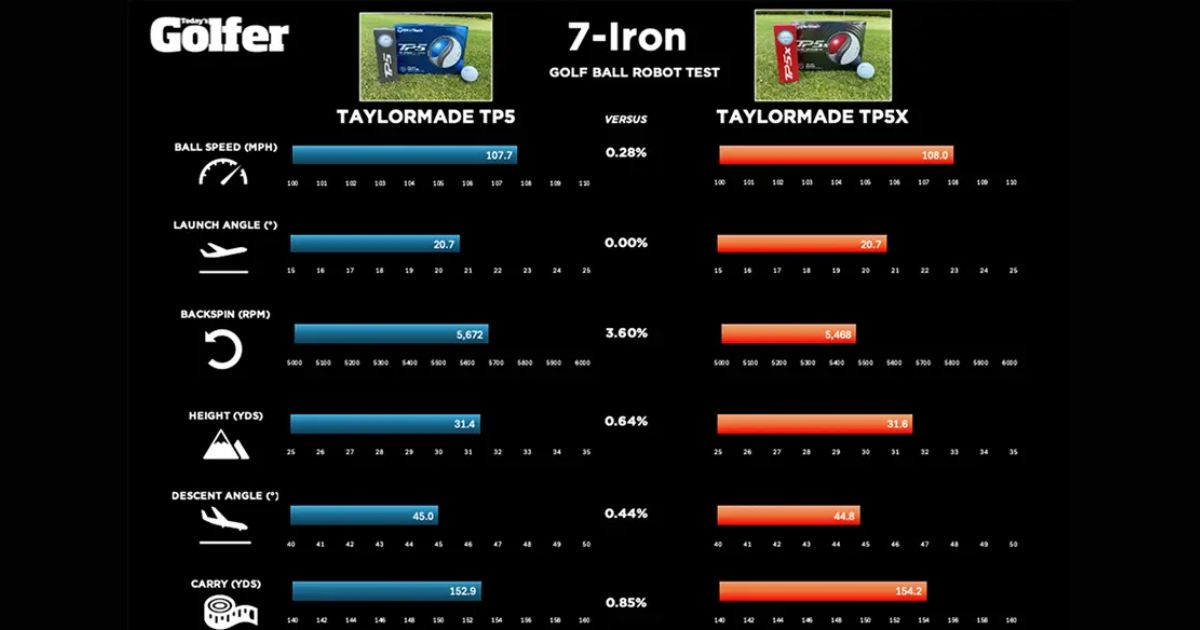
| 7-Iron Metric | TP5 | TP5x | Difference |
|---|---|---|---|
| Ball speed (mph) | 107.7 | 108.0 | 0.28% |
| Launch angle (°) | 20.7 | 20.7 | 0.00% |
| Backspin (rpm) | 5,672 | 5,468 | 3.60% |
| Height (yds) | 31.4 | 31.6 | 0.64% |
| Descent angle (°) | 45.0 | 44.8 | 0.44% |
| Carry (yds) | 152.9 | 154.2 | 0.85% |
TP5 tends to grip slightly more on the first bounce, which some golfers find easier to read for distance control. TP5x flies a touch flatter, which can actually tighten dispersion for some players…
Wedge Performance and Greenside Control
Wedges are where golfers fall in love with a golf ball, and for good reason. There’s something satisfying about watching a ball check hard and stop near the hole, and this is usually the deciding factor for a lot of players.
TP5 uses its thicker urethane cover to dig into wedge grooves, creating that classic one-hop-and-stop reaction that feel-focused players tend to prefer. TP5x still produces solid tour-level spin, but it typically releases a bit more after landing, which some golfers actually prefer since it gives more predictable rollout rather than unpredictable back-spin surprises.
It’s worth remembering that too much spin isn’t always a win either. Some players rip wedges back further than intended and end up short-sided because the ball pulled off the front of the green. If you’re constantly surprised by how much your ball checks, that unpredictability can hurt just as much as too little spin.
| Wedge Trait | TP5 | TP5x |
| Spin level | Maximum | Playable, slightly less |
| Landing behavior | Checks and stops | Checks then releases slightly |
| Best for | Aggressive short game control | Balanced spin with some rollout |
| Groove interaction | Deep bite | Solid but slightly less grip |
One caution here. A worn, scuffed cover changes spin and flight behavior significantly. So if you’re comparing a fresh sleeve of TP5x against a beat-up TP5, you’re not really comparing golf balls anymore. You’re comparing wear and tear, and that comparison won’t tell you anything useful about which ball actually suits your game.
The Simplest Way to Test Both Balls Without a Launch Monitor
You don’t need expensive equipment to figure out which ball suits you better. A real round of golf tells you more than any indoor session, since course conditions, nerves, and real targets reveal things a controlled environment never will.
The key to a useful test is consistency in everything except the ball itself. If you change your tee height, your targets, or your swing effort at the same time you switch balls, you’re no longer running a fair comparison. You’re just adding chaos and calling it data.
| Test Step | What To Do |
| Step 1 | Buy one sleeve or one dozen of each ball |
| Step 2 | Use the same tee height every time |
| Step 3 | Aim at identical targets throughout the round |
| Step 4 | Rotate balls hole by hole for fair comparison |
| Step 5 | Avoid swinging harder just because the ball changed |
| Step 6 | Hit a few shots from light rough as well |
The goal is repeatable conditions, not a single lucky shot.
Common Mistakes Golfers Make When Choosing
A few habits quietly ruin most ball comparisons, and they’re surprisingly common even among experienced players who should know better.
Judging a ball purely on how it spins on a wedge demo mat ignores everything that happens off the tee, which is often where the real difference in scoring potential lives. Assuming the “x” in TP5x automatically means it’s only for fast swingers is also inaccurate, since plenty of moderate-speed golfers play it comfortably because of how it matches their launch and spin needs. Changing tees, targets, or swing effort mid-test introduces variables you can no longer separate from the ball itself, which makes any conclusion unreliable.
| Mistake | Why It Hurts Your Test |
| Judging only on wedge spin demos | Ignores driver and iron performance |
| Assuming “x” means fast swingers only | Many moderate speeds play TP5x well |
| Changing tees or targets mid-test | Adds noise you can’t separate from the ball |
| Judging after 2-3 holes | Even tour pros mishit shots occasionally |
| Ignoring putting feel | Leads to poor speed control on greens |
TP5 vs TP5x by Player Type
Not every golfer should approach this decision the same way, since priorities shift depending on skill level and typical miss patterns.
Low handicap players tend to benefit most from focusing on spin windows and wind flight consistency rather than which ball simply feels more premium. Mid handicap players usually get more value from playable driver flight and predictable chip shots than from chasing small rpm differences that rarely show up in actual scores. Beginners and higher handicap golfers often benefit more from picking one ball and sticking with it long enough to build real feel, rather than switching every few rounds. Senior or slower swing speed players typically need easier launch above almost everything else, though it’s still worth validating with real on-course results rather than assumptions.
| Player Type | What To Prioritize |
| Low handicap | Spin windows and wind flight consistency |
| Mid handicap | Playable driver flight and predictable chips |
| Beginner or high handicap | Pick one ball and build feel over time |
| Senior or slower swing speed | Easier launch, validate with real flight |
Price and Durability Considerations
Both balls sit in the premium tour category, so pricing is similar and tends to shift with seasonal promotions, bulk deals, and retailer sales rather than any major gap between the two models.
Durability matters more than most golfers realize, especially if you practice wedges frequently. Watch for scuffing after heavy practice sessions, cart path scrapes from mishits, and cover shearing caused by aggressive groove wedges. A damaged cover doesn’t just look worse. It quietly changes spin and flight characteristics, which throws off any comparison you’re running between the two balls.
Final Verdict: TP5 vs TP5x
Choosing between tp5 vs tp5x ultimately comes down to knowing your own miss pattern, not chasing marketing claims or tour usage stats. Both balls are excellent. The difference lies entirely in which weaknesses in your game each one helps quietly correct.
If you value a soft feel, precise wedge control, and shot-shaping touch around the greens, TP5 is the stronger fit. If your priority is ball speed, a flatter trajectory, and added distance off the tee, TP5x is the better direction. Neither choice is a compromise, since both models share the same tour-level construction quality.
Whichever you choose, commit to it for a few rounds. Constantly switching golf balls makes it harder to trust your distances and putting speed. Real improvement comes from familiarity, not variety, and the golfers who score best are usually the ones who know exactly what their ball will do before they even swing.
Also Read About: Super Game Improvement Irons: Top 10 Ranked (2026)
Frequently Asked Questions
- What is the main difference between TP5 and TP5x?
TP5 offers a softer feel with higher spin, ideal for short game control. TP5x is firmer and faster, built for distance and a flatter flight.
- Which ball is better for beginners?
Both are premium tour balls. Beginners often benefit more from consistency than from picking a specific model, so choosing one and sticking with it helps build feel faster.
- Does TP5x really add more distance?
Yes, largely because it sheds spin off the driver and long irons, producing a flatter, more penetrating flight that often carries further.
- Is TP5 better for wedge spin?
Generally yes. Its cover is designed to grip wedge grooves more aggressively, creating stronger stopping power on approach shots.
- Can slower swing speeds play TP5x?
Absolutely. Swing speed alone doesn’t determine fit. Launch, spin needs, and strike location on the face matter just as much.
- How should I test TP5 vs TP5x myself?
Play a round using the same tee height and targets, rotating balls hole by hole, and focus on your weakest club rather than one perfect shot.
- Does ball wear affect the comparison?
Yes. A scuffed or worn cover changes spin and flight, so always compare both balls in similar condition for fair results.
- Which ball is best for windy conditions?
TP5x’s flatter flight and lower spin usually handle wind better, while TP5’s higher launch can balloon slightly in strong gusts.