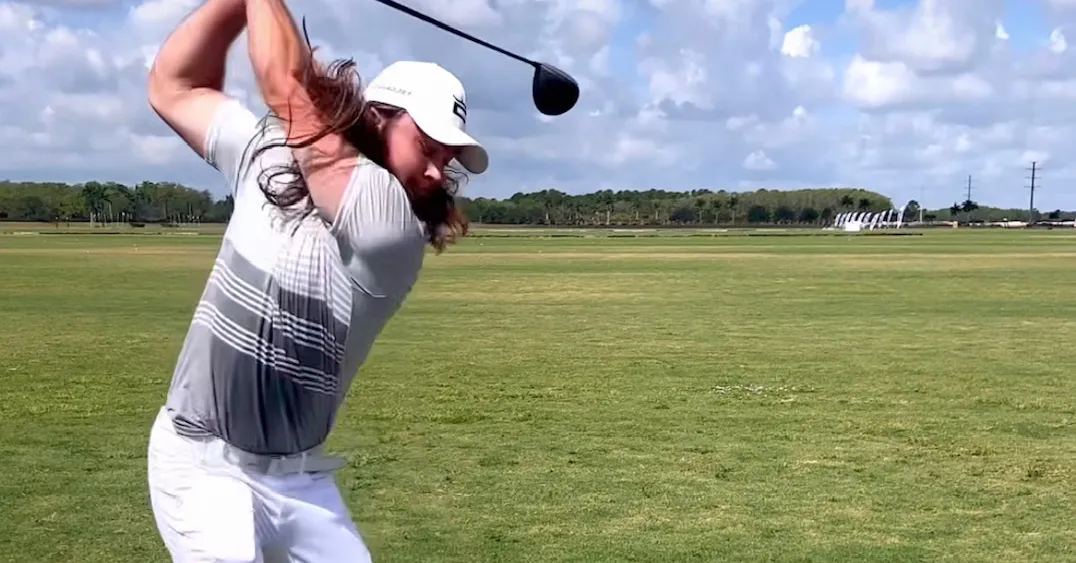
There is nothing in golf that causes instant excitement than seeing the ball shot up into the air and continue flying even after no one thinks it will ever come down. Raw strength is not the only way to make the longest drive in golf. It embodies time, course development, equipment development, physical training and endurance, and psychological confidence in the face of stress.
Distance has transformed the playing of professional golf. It has impacted upon course structure, tournament design and even training techniques. There were historic drives due to solid fairways. Others depended upon rises of the ground. Some of them were produced through mere athletic skill. We dissect the most notorious long drives in the history of the tournament and inquire as to what made each of them possible in this detailed guide.
What Does the Longest Drive in Golf Actually Represent?
The maximum officially measured tee shot in the field of golf is known as the longest drive in golf. The definition of that sounds easy, but the truth is even more complicated. Carry distance and roll is counted in total yardage. A drive landing on a slope will go a long long way compared to one landing on flat ground.
Tournament context also matters. A long drive during competitive play holds greater significance than one recorded during practice. Measurement systems have improved over time. Early records relied on physical measurement, while modern events use advanced tracking technology.
Distance reflects more than power. It shows efficient energy transfer from clubface to ball. It demonstrates optimal launch angle and controlled spin. When these elements align perfectly, extraordinary yardage becomes possible.
Carl Cooper’s 787-Yard Drive: The Most Extreme Example
In 1992, Carl Cooper made what can be considered as the longest drive in golf. He was playing in an event in the Texas Open at the Oak Hills Country Club whereby he hit a tee shot at a par four shot that ended up covering a distance of 787 yards.
The ball landed on a concrete cart path angled downhill. Once it made contact with the hard surface, the bounce amplified the distance significantly. Gravity increased momentum as the ball accelerated down the slope. By the time it stopped, the measurement stunned officials and spectators alike.
Although this remains the longest drive in golf by total yardage, it came with irony. Cooper recorded a double bogey on the hole. The extraordinary distance did not translate into scoring advantage. That contrast highlights an important truth in golf. Distance alone does not guarantee success.
Mike Austin’s 515-Yard Drive: The Pure Power Benchmark
Mike Austin has 515 yards in 1974, and it is widely known by many historians and players that this is the greatest pure strike of all times. He did this distance at the U.S. National Seniors Open Championship in Las Vegas when he was 64 years old.
Austin took a persimmon wood driver, and a conventional balata ball. There were no modern lightweight shafts or multi-layers balls available. The fairway was solid, and there was no artificial bounce that would help the roll. The swing solely depended upon mechanics, time, and athletics.
This motivation is still known by Guinness World Records. It is still cited when debates on the longest drive in golf are to be discussed. The technique used by Austin focused on full body rotation and balance as opposed to brute force. His success shows that sometimes efficiency can be more productive than aggression.
Tiger Woods at Kapalua: Modern Power on Display
In 2002, Tiger Woods reinforced his physical superiority in the world of golf by shooting a one-long-yardage drive at the Mercedes Championship in Kapalua. Plantation Course is well-known with its extreme elevation variations and large fairways. In the 18 th hole, Woods used downhill slope and outstanding contact.
The ball rolled a long way down and kept on rolling furiously down the cambered fairway. The distance of 498 yards was verified by the modern measurement systems. It was one of the longest drives in the PGA Tour in decades at that time.
The power of Woods altered the perception of competitors towards athletic preparation. His adherence to strength training, flexibility and conditioning made an impact on a generation of golfers. This change in regard to physical fitness is commonly observed through the longest drive in golf in the modern era.
Dustin Johnson: Repeated Power Under Pressure
Dustin Johnson is not seen in the debate on extreme driving distance once. In 2018, he hit a 489-yard shot in the WGC-Dell technologies match play at the Austin country club. In the previous part of his career, he registered a 463-yard drive at the TPC Boston in the Deutsche Bank Championship.
The swing that Johnson uses is a mixture of breadth, rhythm and restrained violence. He does not appear rushed. But his clubhead velocity is always one of the fastest in Tour. Hard summer fairways tended to increase his total yardage.
His repeated appearances on long drive lists show that the longest drive in golf is not always accidental. It can reflect consistent athletic ability paired with optimal conditions.
Additional Historic Tournament Drives
A number of other practitioners made memorable long drives when they were in play. These performances are worthy of attention as they show how different distance records might be.
In 2004, Kapalua was visited by Davis Love III who reached 476 yards. The severe down slope was a factor but his attack needed perfect launching conditions. In 2003 Jeff Sluman had 473 yards at PGA West. Charley Hoffman started his first round of the 2009 Texas open with a 467-yard drive despite having limited practice.
In Mexico City, Justin Thomas had 457 yards in 2019. Since the ball was at high altitude, air resistance was low and it was able to move a longer distance as compared to low altitude. David Duval has 454 yards at the Bob Hope Chrysler Championship, which demonstrates the positive results of the adoption of fitness training.
Each of these drives contributes to the evolving narrative of the longest drive in golf.
Historic Distance Comparison
| Player | Year | Distance | Event | Primary Influence |
| Carl Cooper | 1992 | 787 yards | Texas Open | Cart path bounce |
| Mike Austin | 1974 | 515 yards | Seniors Open | Pure strike |
| Tiger Woods | 2002 | 498 yards | Mercedes Championship | Downhill slope |
| Dustin Johnson | 2018 | 489 yards | WGC Match Play | Firm fairway |
| Davis Love III | 2004 | 476 yards | Mercedes Championship | Steep terrain |
This comparison shows how terrain, equipment, and era shaped results.
The Science Behind Extraordinary Distance
Distance results from precise physical principles. When the clubface meets the ball, energy transfers instantly. Higher clubhead speed produces greater ball velocity. Launch angle determines initial trajectory. Spin rate influences how long the ball remains airborne.
Environmental factors matter as well. Wind can either increase or reduce distance. Elevation decreases air density, allowing the ball to travel farther. Firm turf increases rollout after landing. The longest drive in golf occurs when physical mechanics align with favorable environmental conditions.
Psychological and Strategic Impact of Massive Drives
A towering drive influences both player and opponent. Confidence rises after a powerful strike. Opponents may feel pressure to respond with equal force.
Strategically, distance shortens approach shots. Par fives become reachable in two strokes. Shorter irons improve scoring probability. Momentum often shifts following an extraordinary tee shot. Power affects both physical and mental aspects of competition.
Extended Performance Summary
| Player | Hole | Round | Distance | Scoring Impact |
| Carl Cooper | 3rd | Round 2 | 787 yards | Double bogey |
| Mike Austin | 5th | Championship | 515 yards | Historic record |
| Tiger Woods | 18th | Round 2 | 498 yards | Tour benchmark |
| Dustin Johnson | 12th | Round 3 | 489 yards | Match advantage |
| Justin Thomas | 10th | Round 3 | 457 yards | Altitude benefit |
This table highlights how distance did not always guarantee scoring success.
Ongoing Debate Around the Longest Drive in Golf
Debate continues regarding which drives should count as true records. Some argue that bounce-assisted shots distort fairness. Others believe that all in-play outcomes are legitimate.
Measurement systems today offer greater precision. Future technology may redefine how distance is tracked. Regardless of debate, the fascination with extreme yardage remains strong. The longest drive in golf symbolizes ambition. It represents pushing boundaries within the sport.
Final Thoughts on the Longest Drive in Golf
Longest drive in golf has remained an object of imagination since the sport can be seen as a combination of athletics, physics and drama of the game. Since the pure 515-yard shot of Mike Austin to the mind-boggling roll of 787 yards by Carl Cooper, both records signify a new event in the history of golf.
Distances are not enough to win. But it is changing strategy and it creates modern competition. New milestones can be set as players become more powerful and equipment advances to a higher level. The quest to have the most distant drive in golf will always be one of the most exciting and controversial successes in the sport.
Also Read About :- TaylorMade BRNR Mini Driver