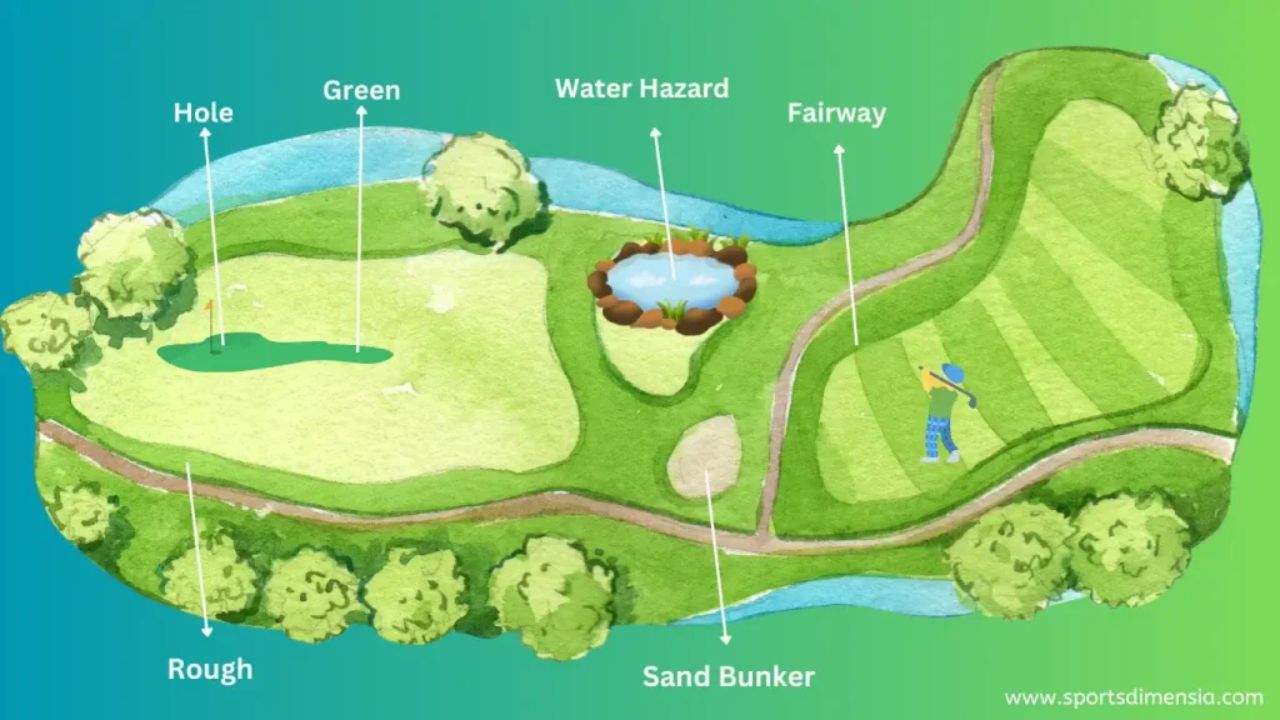
Golf courses tend to appear endless as you get up to the first tee and look out at the fairways which appear to be running away. Most golfers appreciate the view without considering all the space that is necessary to make up such a playing field. Did you ever ask yourself How Many Acres Is the Average Golf Course, and get a more interesting answer than most folks think? Planning of golf courses should be done with a lot of open space and equipped with adequate space to design tricky holes and still maintain the beauty of the terrain. The number of acres per course varies depending on the course, but the general principles of design are similar. Learning the acreage of golf courses can make golfers, investors, developers and lovers of golf realize the magnitude of each game of golf.
Why Golf Courses Require So Much Space?
A golf course is a lot more than a set of holes located on a field. Designers need to reserve land to build fairways, greens, tee boxes, rough lands, cart paths and practice areas, maintenance structures and natural scenery. This makes the land requirement quite large than what many individuals may think.
The golf architects should also be able to have sufficient space to isolate the holes due to safety considerations. Players must not be crowded and golf balls should not keep on entering into adjacent fairways. Hence, more space contributes to the making of an enjoyable and comfortable experience.
Additionally, the contemporary golf clubs are usually equipped with driving range, practice green, clubhouse, and car parks. These extensions make the property size bigger and enhance the experience of visitors.
Main Areas That Occupy Land on a Golf Course
| Course Component | Purpose |
| Fairways | Main playing areas between tee and green |
| Greens | Putting surfaces |
| Tee Boxes | Starting areas for each hole |
| Rough Areas | Challenging grass surrounding fairways |
| Water Features | Lakes, ponds, and streams |
| Cart Paths | Transportation routes |
| Practice Areas | Driving ranges and putting greens |
| Clubhouse Facilities | Dining, lockers, and pro shops |
Since all these need space, golf courses tend to occupy hundreds of acres.
How Many Acres Is the Average Golf Course?
How many acres is the average golf course The most popular response to how many acres of seventy-two holes is the average 18 holes of a typical 18-hole course between 110 and 200 acres. But the size precisely will be determined by the area, course design, topography, and the experience that the player will have.
Smaller urban courses typically cover between 110 -120 acres since land prices are more expensive in the developed regions. In the meantime, resort and championship courses can be found on 170 to 200 or more acres. These bigger properties are wider in fairways, scenic views, and distance of fairways.
A classic 18 hole course is a course that has a total playing length of 5,000 to 7,000 yards. However, the acreage is mostly more than what golfers see since most portions are not disturbed to conserve the natural surroundings.
Average Golf Course Acreage by Type
| Course Type | Typical Acreage |
| 9-Hole Course | 50–100 Acres |
| Compact Municipal Course | 100–120 Acres |
| Standard 18-Hole Course | 110–200 Acres |
| Resort Golf Course | 170–250 Acres |
| Championship Course | 200+ Acres |
These statistics prove that no amount of money can apply to all golf facilities. However, the global range average is unexpectedly similar.
Understanding Golf Ground Size and Course Layout
Looking at the acreage of courses, many give the term golf ground size. The overall size of the property, and the amount of playing field though, is not necessarily the same.
Only a part of the whole property is used as the actual playing corridors. Aesthetics and strategic design Designers tend to hold so much land to prevent environmental, aesthetics and strategic designs. The trees, desert, and wetlands, and variation of elevation all contribute to the total size.
A properly designed golf course is one that is challenging and beautiful at the same time. Open spaces provide a sort of serene environment, and obstacles made by nature augment strategic choices. Thus, the playability and the visual appeal of a golf course depend on the golf ground size.
Overall course dimensions are because of several factors:
- Hole length
- Terrain elevation
- Natural features
- Safety buffers
- Practice facilities
- Clubhouse infrastructure
- Environmental preservation zones
Due to these considerations, a course of same acreage can have a vastly different number of acres.
How Many Acres Do You Need for a Golf Course?
One of the topics of debate among developers and those passionate with golf is the number of acres needed to build a golf course. The response varies according to the nature of the facility under planning.
The space occupied by a small 9-hole course can easily be 50-100 acres. Nevertheless, practical use of an 18-hole facility cannot possible without at least 110 acres of land. Builders willing to have high quality golfing facilities tend to buy much more property to fit a broader fairway and more facilities.
Planners will have to consider:
- Local zoning regulations
- Environmental restrictions
- Water availability
- Future expansion opportunities
- Parking and Clubhouse needs.
- Terrain suitability
These have an impact on the cost of construction and, over time, success.
Land Requirements Based on Course Goals
| Course Goal | Recommended Acreage |
| Small Community Course | 50–80 Acres |
| Public 9-Hole Course | 80–100 Acres |
| Standard 18-Hole Course | 110–180 Acres |
| Luxury Resort Course | 180–250 Acres |
| Championship Facility | 200–800+ Acres |
This continuum illustrates the extent to which golf development is flexible, based on project requirements.
What Determines the Final Size of a Golf Course?
The ultimate acreage of a golf facility depends on a number of factors. Certain classes seem small since they work in highly populated locations. The others intend wide pictures to exploit the natural beauty and exclusivity.
Terrain and Elevation
Hilly land may necessitate the purchase of more land since the holes cannot be stacked as closely spaced as on a flat land. Elevation changes incur space needs and help designers make experiences memorable.
Environmental Features
The size of the property is added to by lakes, streams, desert areas and even protected habitats. The areas are deliberate and even perpetuated by many courses rather than being developed.
Design Philosophy
Other architects love to use open floor plans which indulge rough play. Others make tight corridors of critical hazards. The acreage is influenced by each philosophy.
Player Experience
Privacy and scenery are often given an additional land on luxury facilities. This will make the atmosphere more relaxing and will improve the experience.
Quintero Golf Club: A Great Example of Large-Scale Design
Speaking of the acreage of golf courses, Quintero Golf Club is a good example to think of, how big a facility can be built nowadays. Several golf courses cover a land of about 150 acres, but Quintero covers an area of about 828 acres of desert scenery.
The facility has got the 18-hole championship course, massive rises and falls and breathtaking mountain scenery. The design does not penetrate into a confined area but instead uses the topography, which surrounds the area to make the golfing experience unique.
The golf course is over 7,200 yards long, and it capitalizes on the elevations of about 2,000 feet down to more than 2,600 feet. These natural unevennesses provide a challenge and visual interest.
Quintero Golf Club Snapshot
| Feature | Details |
| Total Property Size | 828 Acres |
| Holes | 18 |
| Par | 72 |
| Yardage | 7,208 Yards |
| Designer | Rees Jones |
| Setting | Arizona Desert |
This case illustrates that top-tier golf centers tend to take up much more land as compared to an average course.
My Experience Walking a Large Golf Course
I recall when I first went to a championship golf course and thought that it would simply be a few minutes between holes. It was, however, only after several hours on the course that I was able to realize just how big these properties are.
Strolling between fairways gave an entirely new vision compared to watching the course on TV. The spacing of the holes, the area of the greens, and the natural setting surrounding the greens were significantly bigger in the actual world.
That experience made me realize why so much land is needed by golf course designers. This additional land area makes it safer and more scenic and provides that tranquil atmosphere golfers prefer. Although there is a description of acreage through the use of statistics, it is walking a course that makes the numbers real.
Does a Bigger Golf Course Mean a Better Golf Experience?
A lot of golf players presuppose that bigger courses offer more enjoyable experiences. Nevertheless, size does not necessarily make quality.
It is possible to have as much fun on a well-planned 120 acre course as on a large resort estate. The most important are the quality of the maintenance, the strategic design, the conditions of the course, and the general atmosphere.
Big courses will tend to offer:
- More scenic views
- Greater hole separation
- Enhanced privacy
- Additional amenities
- Better resort-style experiences
Smaller courses, on the other hand, might provide faster rounds, more accessible courses, and lower cost to operate.
Not all big golf courses are necessarily the best. Rather, it is the course that is able to harmonize land use and design innovation and entertainment of the players.
Conclusion
Knowledge of the acreage of the average golf course will provide golfers with a fresh insight on the planning and design of each round. The average 18-hole course is on between 110 and 200 acres with championship and resort courses far exceeding this. Acreage is one of the most interesting parts of golf course development whether you want to know How Many Acres Is the Average Golf Course, the size of the golf ground, or you just want to know further about golf course development. Big or small, any successful golf course applies its land wisely to make its players have a fine and enjoyable experience which they cannot forget.
Also Read About: Real Estate Golf Course: Investment, Lifestyle & Value