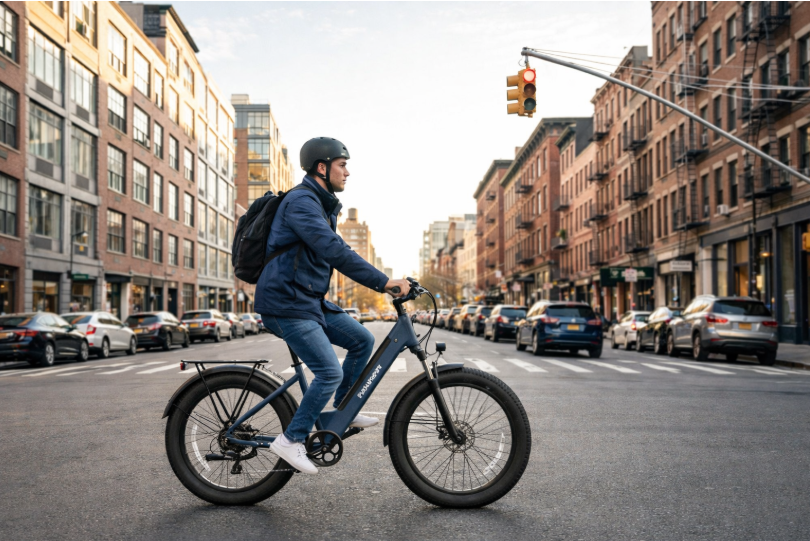
Most advice on choosing a City Commuting Electric Bike starts by comparing bikes.
A more effective approach starts by comparing how people actually ride in cities.
Daily city riding follows patterns. Once you recognize yours, choosing the right City Commuting Electric Bike becomes a process of elimination rather than guesswork.
This article explains how to use your real riding behavior to guide that choice.
City Commuting Is Shaped by Daily Use, Not Occasional Rides
Most city commuting doesn’t happen as one long ride. It happens in pieces — short trips, repeated routes, and familiar streets used again and again. Over time, these repeated rides matter far more than occasional longer journeys or weekend use.
This is where many buyers misjudge what they need. A bike can feel impressive during a test ride or on a rare uninterrupted route, yet become inconvenient when used several times a day. Daily use highlights small details: how easy it is to start riding, how natural it feels to stop and go, and whether the bike fits smoothly into routines without requiring extra thought.
For city commuting, convenience compounds. A City Commuting Electric Bike that feels effortless on short trips tends to be used more often, while one that requires preparation or adjustment slowly falls out of regular use.
At this stage, practicality matters more than potential. The right City Commuting Electric Bike supports repetition without demanding attention.
In the City, Control Matters More Than Momentum
Urban riding rarely rewards steady cruising. Instead, it is defined by constant changes in speed and direction. Traffic signals, intersections, pedestrians, and shared spaces force riders to slow down, stop, and restart far more often than they ride at a consistent pace.
Because of this, the moments that define riding comfort are not high-speed stretches, but low-speed interactions. How a City Commuting Electric Bike behaves when starting from a stop, navigating tight corners, or adjusting speed in traffic has a direct impact on confidence and stress levels.
A City Commuting Electric Bike that feels stable and predictable during these moments reduces mental effort. Riders can focus on their surroundings rather than managing the bike itself. Over time, this sense of control becomes one of the strongest indicators of whether a bike truly suits city use.
Momentum may feel satisfying in open conditions, but control is what makes everyday urban riding manageable.
Carrying Everyday Items Changes How a Bike Feels
In real city use, riding empty-handed is the exception, not the rule. Backpacks, work items, groceries, and daily purchases quickly become part of normal commuting. These loads may seem minor, but they significantly affect how a bike feels.
Added weight changes balance, especially during starts, stops, and turns. Bikes that feel responsive when unloaded can become awkward once carrying is introduced. This is often where design differences become obvious, even if they were not noticeable during a short test ride.
A suitable City Commuting Electric Bike remains composed when weight shifts. It should feel stable when stopping at intersections, predictable when turning, and balanced when moving at low speeds. This stability allows riders to move through the city with confidence rather than caution.
Here, consistency matters more than versatility. The goal is not to carry everything perfectly, but to handle everyday loads without disrupting the ride.
Real Streets Reveal What Specs Can’t
Specifications rarely reflect how a bike interacts with real streets. Cities introduce conditions that are difficult to capture on paper: uneven pavement, narrow lanes, limited parking space, and frequent moments where the bike must be maneuvered slowly or guided on foot.
These everyday situations expose mismatches between design intent and actual use. Bikes optimized for ideal surfaces or aggressive riding styles often feel out of place once faced with urban constraints. What initially feels capable can become demanding when conditions are less than perfect.
A City Commuting Electric Bike that handles these moments calmly tends to integrate better into daily life. Ease of maneuvering, tolerance for imperfect surfaces, and adaptability to tight spaces all contribute to long-term usability.
Real streets reward bikes that are forgiving, not just capable.
Choosing by Elimination, Not Comparison
Choosing a City Commuting Electric Bike does not mean finding the most impressive option available. It means narrowing choices based on how riding actually unfolds, day after day.
By focusing on repetition, interruption, carrying needs, and real urban limits, many options remove themselves early in the process. Bikes that demand constant adjustment or rely on ideal conditions rarely survive this filter.
What remains are City Commuting Electric Bikes designed to blend into daily movement rather than compete for attention. At that point, comparison becomes easier — because only options that already fit how you ride are left.
This approach does not promise a perfect bike.
It does something more useful: it helps you avoid the wrong ones.