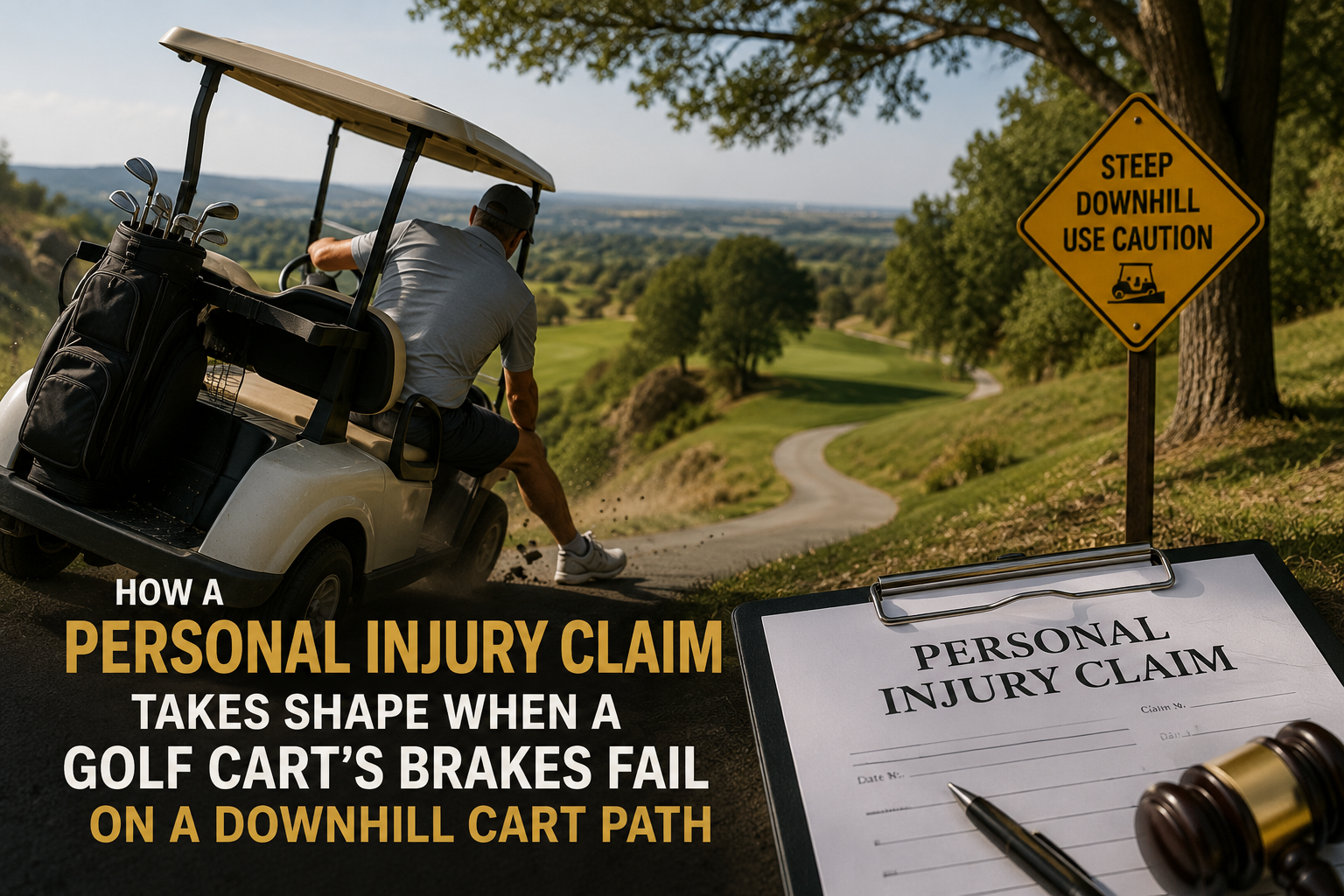
Golf carts feel harmless to most people who hop in for a quick ride between holes. They move slowly and sit low to the ground, so few players think twice about the braking system underneath them. Nothing about the design suggests danger the way a car or motorcycle might, which makes the risk easy to overlook. Yet a cart carries real weight and momentum, and its brakes depend on regular upkeep to work when it actually matters.
A downhill stretch puts real pressure on a cart’s brakes, since gravity adds momentum that a flat fairway never demands. If the pads are worn or the fluid runs low, a driver may not notice until the cart is already picking up speed. A cart that won’t slow down can clip a tree, flip on a curve, or throw a passenger against the frame, and none of that requires bad weather, only a machine that wasn’t checked closely enough.
When a Mechanical Failure Turns Into a Legal Question
Once a cart stops responding to the brake pedal on a hill, the accident that follows happens within seconds, leaving little time for anyone to react. A driver might walk away with bruises, while a passenger ends up with a fractured wrist or a head injury from being thrown against the dashboard. Medical bills start arriving almost immediately, and many of those costs aren’t fully covered by standard insurance. Questions about who last serviced the cart’s brakes become relevant overnight.
According to the Weston & Pape legal team based in Largo, Florida, personal injury law provides the framework for sorting out these situations, focusing on whether negligence caused harm that could have been prevented. If a course knew a cart had brake trouble and sent it out anyway, that failure can shift financial responsibility onto whoever created the danger. A person hurt in a cart accident may be entitled to compensation for medical treatment and lost income, and players across Pinellas County face this same risk wherever a course sits on hilly terrain.
A Routine Round Turns Into a Long Recovery
Living in Largo doesn’t shield anyone from this kind of mechanical failure if a cart’s brakes give out on a familiar course with even a slight downhill grade. A passenger riding along would have little warning before the cart picked up speed on a slope that never seemed risky before. Once the brakes gave out, a hard impact against a drainage culvert or curb could easily throw a rider against the side rail, resulting in a fracture or worse.
In the days that follow an incident like this, paperwork tends to pile up quickly, including insurance forms, medical billing codes, and requests for documentation about missed work. A local attorney would likely point out that a course’s maintenance logs matter more than most people expect, since a documented history of skipped brake inspections can shift responsibility away from the injured rider. Recovering from an injury like this often means balancing physical therapy appointments with repeated calls to insurance adjusters, all while making sure medical costs don’t fall on someone who wasn’t at fault.
A Family in a Nearby Community Faces a Similar Scare
A family living in Ridgecrest could encounter a similar scenario during a routine weekend round at a local course. If a cart carrying a teenager lost braking power on a gentle downhill approach, the cart could easily drift into a bunker or off the path entirely. A hard jolt against the frame could result in a head injury serious enough to require urgent care and a follow up scan.
Filing a claim for a minor’s head injury tends to be more complicated than most parents expect, since medical providers want documentation connecting the injury directly to the mechanical failure that caused it. A course manager might grow less cooperative once a maintenance record request suggests the course’s own liability is being examined. Keeping copies of every message and repair estimate becomes essential, since a thin paper trail can undermine an otherwise legitimate claim months down the road.
A Different Kind of Traffic Adds to the Risk
Golf courses built next to busy retail corridors face a version of this risk that quieter, more rural courses rarely deal with. A course bordering the West Bay Drive corridor sees a steady stream of staff, delivery trucks, and golfers arriving throughout the day, putting extra pressure on carts already in heavy daily use. Commuters heading in from Walsingham Road often arrive right at opening time, meaning the first carts sent out each morning are the least likely to have been checked the night before.
A grounds crew member commuting from Anona, another small community outside Largo, would likely describe the morning rush as the most unpredictable part of the job. Carts get pulled from storage quickly and keys get handed out fast, leaving little time for the slow brake check that afternoon shifts allow. A rushed morning routine, repeated daily, could quietly become the kind of documented pattern that supports a personal injury claim if something eventually goes wrong.
The Real Lesson Behind a Cart That Wouldn’t Stop
Someone who plays regularly in Belleair Bluffs could easily encounter this same risk after years on courses across the region without a single brake related incident. Experiencing a brake failure firsthand tends to change how a person looks at every cart they step into afterward, since maintenance schedules and brake fluid levels rarely cross a golfer’s mind beforehand. An injury like a shoulder fracture or dislocation could require multiple rounds of therapy and a claims process that stretches on for months.
Every golf course, whether it sits by a busy corridor or a quiet residential neighborhood, carries some version of this same mechanical risk once carts start rolling down real hills instead of flat cart paths. Regular brake inspections, honest maintenance records, and quick documentation after any incident make the difference between a fair resolution and a drawn out dispute. Players who know this risk exists ahead of time tend to react faster if something goes wrong. A brake failure on a downhill stretch will always be sudden, but how a course, a driver, and an injured player respond afterward is what actually determines how the story ends.