Often we hear about it at home, but rarely talk about it, securing one’s family’s future, do we not? Indians have a habit of saving for a rainy day. In fact, a gold coin or a fixed deposit can be anything. The idea is to always keep your children and parents stress-free and safe.
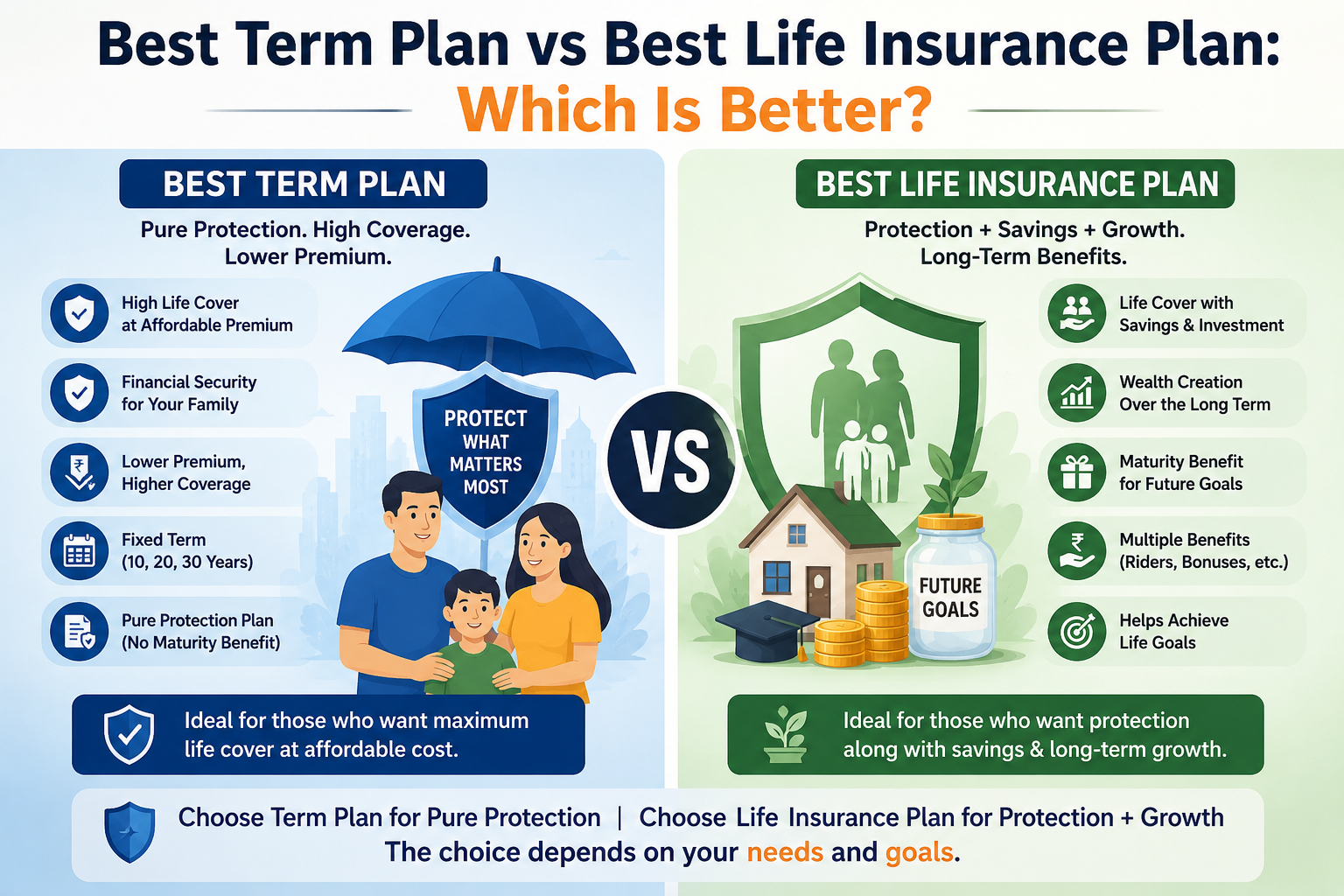
On digging a little deeper, you will see two main options coming up: a best term plan or a best life insurance plan. They may sound the same, but they actually differ widely. Here is an analogy: one is a safety helmet, and the other is a savings jar with a cover.
What is a Term Plan? (The Pure Protection)
The best term plan is actually the most basic kind of insurance that you can get.
- How it operates: You decide to pay an amount (called a premium) regularly, say yearly, for a period that can be from 20 to 30 years, for example.
- The Guarantee: If during that time something unfortunate happens to you, the insurer pays a huge sum of money to your family.
- The Limitation: In case you live beyond those 30 years, your policy simply expires, and you get nothing back.
Why it is very popular: It is extremely affordable. Just for the cost of a couple of pizzas a month, you can get a guarantee of your family receiving ₹1 Crore in case you are no longer there to provide for them. It is “pure protection.”
What is a Life Insurance Plan? (The Savings Jar)
In India, the term “life insurance plan” usually refers to “Endowment” or “Money-Back” plans. These are really the best life insurance plans if you want returns on your premium money.
- Mechanism: You pay a higher premium. A part of the premium is for your life cover, and the rest is invested by the company.
- Trade-off: Your family will get the money if you meet with an untimely death. If you survive the policy term (say 20 years), the company will pay you a large amount of money (the “maturity benefit”).
- The disadvantage: Premiums are much higher because you’re getting some money back; usually, they are 10 times more than term insurance for the same cover.
Term vs. Life Insurance: A Simple Comparison
To explain the differences between the two, here is a quick summary that even teens and elders can understand:
| Feature | Best Term Plan | Best Life Insurance Plan |
| Main Goal | High protection for family | Savings + some protection |
| Cost (Premium) | Very Low | High |
| Money back at end? | No (Usually) | Yes |
| Cover Amount | Very High (e.g., ₹1 Crore+) | Medium to Low |
Which One Should You Choose?
The choice between two should be influenced by what you need the most at the moment.
Go for a Term Plan if:
- You are the sole breadwinner: You would want to ensure that your family can pay for the house, school fees, and food even in your absence.
- You want to save money: You want the most coverage for the least amount of money.
- You save in other ways: You would like to have your insurance and your savings (like putting money in mutual funds or gold separately) separated.
Get a Life Insurance Plan if:
- You want “forced” savings: You are someone who has a difficult time saving money and would like a plan that will give you a lump sum after 15 or 20 years.
- You do not like risks:: You want a secure haven for your money that also provides you with some life cover.
- You wish to save for a future event: A lot of parents choose these types of plans to save for their child’s wedding or higher education.
A Middle Path?
Many people nowadays opt for a “Term Plan with Return of Premium”. In this case, if the policyholder survives the term, all the premiums paid by the policyholder are returned. Although the cost is slightly higher than a simple term plan, it provides some comfort to the ones who cannot reconcile with the idea of “losing” money.
Make it a habit to look at the Claim Settlement Ratio of the company always. This figure informs you of the number of claims out of 100 that the company has actually paid. Generally, a higher number (above 97%) is preferred.
Summary
To put it simply, a good term plan works like a lifeline, it is there to financially support your family if something unfortunate happens. A good life insurance plan, on the other hand, is like a piggy bank, which, along with a small safety net, also serves as a backup in case of emergencies.
For the majority of new families in India, industry insiders recommend initially buying a term plan. Why so? Because at the very least, it is essential to ensure that the family is able to maintain their standard of living comfortably in the absence of the breadwinner. After securing the “big shield,” one can consider other avenues for the investment of long-term savings. Have a conversation with your family today. It can be very rewarding to know these simple steps that can change your life in the future.