Most people describe Amsterdam through its bikes, canals, and museums. Very few describe it as a serious swimming city. They should. Underneath the tourist postcards, the Dutch capital has quietly built one of the most active adult swimming cultures in Europe, and a growing number of professionals, expats, and late-starters are finally jumping in.
According to the Royal Dutch Rescue Brigade (Reddingsbrigade Nederland), an estimated one in three adults in the Netherlands still feels uncomfortable in deep water, and the share is significantly higher among adults who arrived in the country after childhood. That’s a quiet public-health gap in a country built around water, and it’s one reason adult swimming lessons in Amsterdam have shifted from a niche service to a mainstream need.
Water Runs Through Everything in Amsterdam
Amsterdam sits on more than 165 canals, the IJ waterway, the Amstel river, and the North Sea Canal. Locals live within walking distance of open water almost everywhere. Children here are taught from age four to earn a Swimming Diploma (Zwemdiploma A, B, and C) before they’re considered safe around water. The Dutch government and municipalities take aquatic competence seriously enough that it’s practically civic infrastructure.
For Dutch adults who grew up in this system, swimming is second nature. But for the tens of thousands of expats, international professionals, and late-arriving residents moving to the city each year, swimming isn’t automatic. Many grew up in places where pools weren’t accessible, lessons weren’t affordable, or cultural attitudes toward water were different. Amsterdam’s water-first lifestyle quietly forces the issue.
Why More Adults Are Finally Starting Swim Lessons Later in Life
The demand for adult beginner lessons has grown noticeably in the past few years, and the reasons are more varied than you’d think.
Fitness. Swimming is one of the few sports that’s genuinely low-impact, full-body, and sustainable into your 70s and 80s. Dutch GPs routinely recommend it for knee issues, lower-back pain, and post-injury rehab.
Triathlon and open water. Amsterdam hosts the Amsterdam City Swim in the Amstel, feeder races for Ironman events across Europe, and a steady calendar of open-water training days in the Sloterplas. Adults get into triathlon, panic about the swim leg, and look for a proper coach.
Expats and internationals. A significant share of adult learners in Amsterdam are professionals relocating for work in tech, finance, and research. They didn’t grow up with lessons, and then they suddenly find themselves on canal boats, at the beach in Zandvoort, or watching their kids learn to swim faster than they can.
Aquaphobia. Genuine fear of water is more common than people admit. In coaching adults over the years, we’ve found that adult learners with aquaphobia often progress faster than they expected, because they’re motivated, patient, and willing to slow down.
What Good Adult Swimming Lessons in Amsterdam Actually Look Like
Not every swim school in Amsterdam is set up for adults. Many pools still run programs optimised for children’s swim diploma pathways, which means large groups, loud environments, and a pace designed for seven-year-olds. That’s fine for kids. It’s rough for a 42-year-old tech manager who’s nervous about putting his face in the water.
Serious adult swimming lessons tend to share a few traits. Small groups, ideally no more than four or five swimmers per lane. Technique-first progression, meaning balance, breathing, and body position before stroke endurance. Coaches who understand adult anxiety and don’t push people past what feels safe. And a clear progression map, from “I can’t put my face in” to “I can swim 1500m freestyle,” rather than a vague “come back next week.”
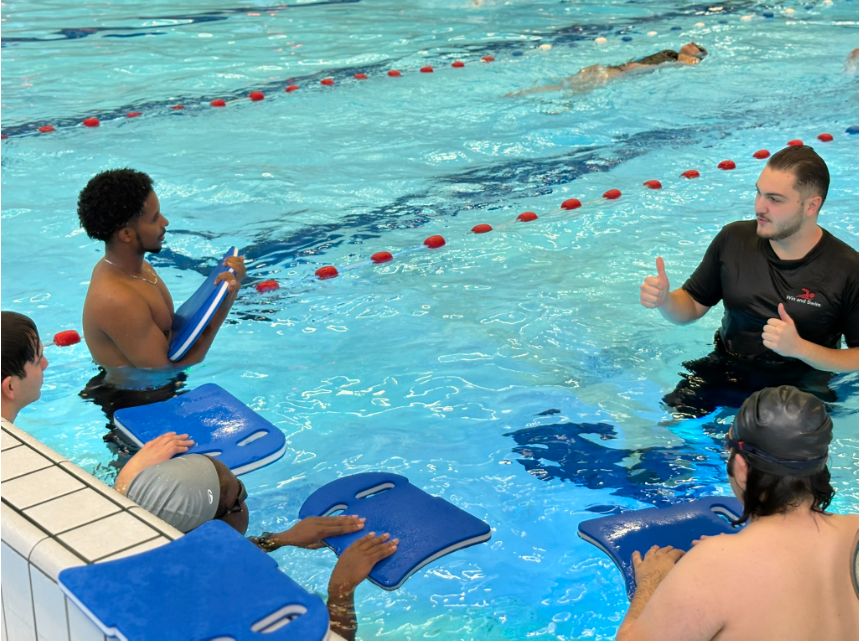
At Win and Swim, a swim school based in Amsterdam-Noord, the coaching team specialises entirely in adult learners: beginners, aquaphobia recovery, intermediate swimmers who want cleaner freestyle, and triathletes prepping for open water. That adult-only focus matters more than it sounds. The training loads, the communication style, and even the pool scheduling are completely different from children’s programs.
Amsterdam-Noord Is Quietly Becoming the City’s Adult Swim Capital
If you’ve only visited Amsterdam as a tourist, you’ve probably never crossed the IJ. That’s a mistake, and not only for swimming. Amsterdam-Noord has transformed over the past decade into the city’s cultural and residential frontier, with the EYE Film Museum, the A’DAM Tower, and a growing network of quiet, well-maintained public pools.
It’s also become a hub for adult-focused swimming. The neighbourhood’s pools are less crowded than those in the city centre, and the coaching culture has shifted toward small-group adult instruction. Organisations like Win and Swim have built entire curricula around the rhythms of working adults, early-morning lanes before the office, evening technique sessions, and private lessons for people who can’t face a group setting yet.
Ask any coach in the neighbourhood and they’ll tell you the same thing: the fastest-growing category of swimmers in Amsterdam isn’t kids. It’s adults in their 30s, 40s, and 50s finally learning what they never got around to.
A Practical Path for Adult Beginners in Amsterdam
If you’re an adult thinking about finally starting, the progression is more predictable than you’d expect. Here’s the rough path most late-starters follow.
- Water comfort. Face-in-water breathing, floating, relaxing the neck and shoulders. Usually two to four sessions if fear of water is involved.
- Balance and body position. Learning to lie flat on the water without sinking legs. This is where most self-taught adults get stuck for years.
- Freestyle breathing. Rotating to breathe on one side, then bilateral. The single biggest bottleneck for adult learners.
- Endurance. Stringing together 25m, then 50m, then 200m without stopping.
- Stroke refinement and other strokes. Backstroke, breaststroke, and eventually open-water skills if you want them.
Most adults following structured lessons reach confident freestyle within 10 to 16 sessions. If you want a deeper look at how that timeline breaks down by skill level, the Win and Swim guide to adult swimming lessons in Amsterdam lays out what to expect at each stage.
The key is this: don’t wait for the “right time.” Adult learners consistently wish they’d started earlier. The longer water stays intimidating, the more emotional weight it picks up, and that weight is harder to shift than any technique issue.
FAQ
How long does it take an adult to learn to swim in Amsterdam?
Most adult beginners following structured lessons reach confident freestyle within 10 to 16 sessions. Learners with aquaphobia or no prior water experience may need a few more; former swimmers returning after years out of the water usually progress faster.
Are adult swimming lessons in Amsterdam expensive?
Group adult lessons in Amsterdam typically range from €25 to €45 per session, depending on pool, group size, and coach experience. Private one-on-one lessons sit in the €60 to €90 range. Many schools offer discounted 10-lesson packages for adult beginners.
Do I need a Dutch swimming diploma as an adult?
No. The Zwemdiploma A, B, and C system is designed for children and is not legally required for adults. However, achieving the same skill level, being able to swim 100m in clothes, for example, is a reasonable safety benchmark for anyone living in a water-dense country.
Can I learn to swim at 40 or 50?
Yes. Coaches across Amsterdam report that the majority of adult beginners fall between 30 and 55. Age is rarely the limiting factor. Consistency and a calm instructional environment matter far more than fitness or flexibility.
What’s the best neighbourhood in Amsterdam for adult swim lessons?
Amsterdam-Noord has developed a strong adult-focused coaching scene, with quieter pools, smaller class sizes, and schools that specialise in adult learners rather than children’s diploma pathways. Central Amsterdam pools can work, but they’re often busier and more child-oriented.
Amsterdam has spent a century engineering its relationship with water. The adults catching up now aren’t an exception, they’re part of what makes this city take swimming as seriously as it does bicycles.